

























When someone asks me, “So what do you do?”, I already know that just “I work with ServiceNow” isn’t enough. Not only do many people not know this platform even exists, but it’s also worth specifying what role you play. After all, saying “I work in a hospital” doesn’t tell you whether I’m a neurosurgeon, a midwife, or someone keeping the operating room clean.
ServiceNow is a platform around which an entire spectrum of professions has grown – from administrators configuring forms to architects designing the structure of an entire enterprise, from process consultants translating ITIL into business language to project managers coordinating multi-month implementations. Each of these roles calls for a different set of skills, a different personality, and there are different ways to get into the ecosystem.
What’s more, even choosing a role is only the beginning. In practice, I see that even experienced developers and consultants at some point face the question of specialization: do I go deeper into ITSM, do I grow into HRSD, or should I focus on integrations and automation? That decision has real career consequences, and it’s not worth putting off for too long.
This article is a map of the ecosystem – a description of the roles, the required skills, the personality traits that help you succeed, and practical tips on how to enter a given path. So here you’ll find the answer to the question: what’s worth knowing before you make the decision.
A map of the ecosystem – three paths, dozens of combinations
Roles in the ServiceNow ecosystem can be divided into three main paths. These aren’t rigid categories, because in practice, many people combine elements of several paths, especially early in their careers. But they help you understand which direction you’re heading.
| Role | Path | The key question it answers |
| Administrator | Technical | How do you maintain and configure the platform? |
| Developer | Technical | How do you build and extend functionality? |
| Architect | Technical | How do you design the platform for the years ahead? |
| QA Engineer / Tester | Technical | How do you ensure implementation quality? |
| Process Consultant | Process | How should business processes work? |
| Business Analyst | Process | How do you translate business needs into requirements? |
| Implementation Consultant | Process | How do you implement the platform in line with best practices? |
| Project Manager | Project | How do you deliver the implementation on time and on budget? |
| Platform Product Owner | Project | How do you grow the platform in line with the organization’s needs? |
| Technical Lead | Project | How do you combine technical responsibility with management? |
A few observations from practice: the line between the technical and the process path is often fluid – a good ITSM developer understands the processes they implement, and a good process consultant knows what the platform can do. People who can move skilfully between both worlds are extremely valued on the market and particularly hard to replace.
I often see that the hardest part of the work isn’t technical or process-related – it’s about communication. The ability to talk to the business, to translate technical constraints into the language of decisions, and to listen to what the client actually needs (not just what they ask for) – that is a cross-cutting competence that separates a senior from a junior regardless of path.
Technical roles
ServiceNow Administrator
Administrator is often the first role through which people enter the ecosystem, especially those working on the side of a client who has implemented the platform and needs someone to maintain it. It’s a role that’s easy to underestimate but which in fact requires broad knowledge of the platform.
An administrator doesn’t write code (at least not primarily), but configures: forms, views, lists, notifications, groups, roles, SLAs, the service catalog, reports, dashboards. They know the platform from both the user’s and the administrator’s point of view and are the first point of contact when something breaks or someone needs a change.
| ServiceNow Administrator; Technical |
| What you need to know: Platform configuration (forms, views, ACLs, SLAs, service catalog, notifications, reports). Knowledge of table structure and the data model. Managing users, groups, and roles. Basic ITIL knowledge. CSA certificate as an entry point. Traits that help: Thoroughness and attention to detail. Patience when working with users. Prioritization skills (many small tasks at once). Communication skills – the admin is often the face of IT for the rest of the company. |
ServiceNow Developer
Developer is the role with the widest variance on the market, from someone writing simple scripts to a senior designing the architecture of scoped applications and integrations with several external systems. It’s also the role that most strongly calls for conscious specialization.
In practice, a ServiceNow developer is someone who builds what can’t be achieved through pure configuration: Flow Designer with business logic, custom portal widgets, integrations via REST API or IntegrationHub, automation scripts, platform extensions as scoped applications. The working language is JavaScript (server and client), with knowledge of GlideAPI, HTML, and CSS for the front-end layer.
| ServiceNow Developer; Technical |
| What you need to know: JavaScript (though even someone who knows “classic” JavaScript has to learn to work with the APIs dedicated to ServiceNow). Flow Designer and automation. REST API and integrations. Knowledge of the platform’s data model. Scoped applications and upgrade-safe development. CAD and CIS certificates for your chosen specialization. Traits that help: Analytical thinking. Curiosity about the platform – ServiceNow changes every six months. The ability to read documentation. Patience when debugging. The ability to work with unclear requirements (because the business rarely knows exactly what it wants). |
Developer specializations – the unavoidable choice
This is a moment few people talk about at the start of a career, but which, in practice, is one of the more important ones. After several years of work, a ServiceNow developer almost always has to answer the question: What do I want to be an expert in?
Specializations are de facto defined by the platform module or by a technical area. Below are examples of areas in which you can specialize, though we’ll come back to the topic of available areas:
- ITSM / Core platform – incidents, changes, problems, service catalog. The most universal specialization; it’s most often assumed that every developer will move smoothly here.
- HRSD (HR Service Delivery) – onboarding, offboarding, employee matters, integrations with HR systems. Requires an understanding of HR processes.
- CSM (Customer Service Management) – external customer service, Cases, B2C portals.
- ITOM (e.g., Discovery or Service Mapping) / CMDB – infrastructure, configuration management. Technically very demanding.
- Integrations and API – IntegrationHub, REST/SOAP, MID Server, middleware. Requires broader knowledge of systems architecture.
- Now Assist / AI – the newest and fastest-growing specialization; requires an understanding of GenAI in the context of the platform.
- App Engine/citizen development – building applications, governance. A hybrid role: technical and advisory.
From my experience, many people spend their first years trying to be an expert in everything. That’s understandable, because the platform is broad and tempting. But the job market and clients are increasingly looking for specialists, not generalists. This doesn’t mean you have to lock yourself into one niche forever, but it’s worth consciously choosing an area where you want to be genuinely good.
ServiceNow Architect
An architect is a role you grow into – it’s rarely the first step in a career. It calls for broad technical experience, but also for something you can’t learn from documentation: architectural intuition, meaning the ability to anticipate how today’s design decisions will translate into problems or opportunities two years from now.
The architect designs the structure of an implementation: the data model, the approach to integrations, scoped vs. global strategies, the technical roadmap, development standards, and governance. Often they don’t write code – but they know what code should be written, and why.
| ServiceNow Architect; Technical |
| What you need to know: Deep knowledge of the platform in at least two modules. Designing scalable architectures. Knowledge of CSDM, data models, and upgrade strategies. Understanding of integration patterns. CTA (Certified Technical Architect) certificate as the target. Traits that help: Long-term thinking. The ability to communicate with executives and the business. The ability to defend architectural decisions under pressure. Humility – a good architect knows that there is often more than one good solution. |
ServiceNow QA Engineer/Tester
The QA Engineer role is less often mentioned in the ServiceNow ecosystem, but is genuinely present – particularly on larger projects and in organizations with mature software development processes. QA is responsible for implementation quality: they plan and run tests, verify that the delivered solution meets the requirements, coordinate UAT (User Acceptance Testing), and make sure that changes on the platform don’t break what was working before.
The platform offers a dedicated tool for this – the Automated Test Framework (ATF) – which lets you build and run automated regression tests. A good QA in ServiceNow is someone who understands the platform well enough to know what could go wrong after an upgrade or after new functionality is delivered – and who can verify that before it reaches production.
| ServiceNow QA Engineer/Tester; Technical |
| What you need to know: Designing and executing manual and automated tests (ATF, Automated Test Framework). Creating test cases and test plans. Coordinating UAT with business users. Platform knowledge at a level that allows regression-risk assessment. Integration tests and post-upgrade tests. Defect reporting and cooperation with developers in resolving them. Traits that help: Thoroughness and attention to detail. Discipline in documentation. The ability to think about what could go wrong. Assertiveness – a good tester must be able to raise issues even under time pressure. Good communication with the technical team and the business. |
Process and consulting roles
The process path is often underestimated by people entering the ecosystem with a technical background. Meanwhile, it’s one of the most valuable roles on an implementation project and one of the hardest to fill with a strong candidate, because it requires combining platform knowledge with a deep understanding of business processes.
Process Consultant
A Process Consultant is someone who understands how ITSM, HRSD, CSM, or other processes should work and is able to design or restructure those processes in the context of a ServiceNow implementation. It’s not just knowing ITIL or other frameworks. It’s the ability to talk to the client about how their organization works, and to advise on how it should work.
| Process Consultant; process |
| What you need to know: Deep knowledge of one or several frameworks (ITIL 4, HRSD best practices, CSM patterns). Process mapping skills. Knowledge of the platform’s capabilities in the context of processes. CIS certificates for module specialization. Traits that help: Empathy toward the client. The ability to ask difficult questions. Assertiveness – a good consultant tells the client when their process is bad, rather than merely digitizing what already exists. The ability to run workshops and presentations. |
Business Analyst
The BA on a ServiceNow project is the bridge between the business and the technical team. They gather requirements, translate them into user stories and functional specifications, and verify whether the delivered solution answers the business need. It’s a role that requires being understood by both the business and the developers at the same time, which is harder in practice than it sounds.
| Business Analyst; process |
| What you need to know: Requirement-gathering techniques (interviews, workshops, documentation analysis). Writing user stories and acceptance criteria. Basic knowledge of the platform – enough to know what is possible. Knowledge of Agile and Scrum. Traits that help: Active listening. The ability to operate at different levels of abstraction. Precision in written communication. Comfort with ambiguity – business requirements are rarely complete and clear from the start. |
Implementation Consultant
Implementation Consultant is a hybrid role – it combines process and technical knowledge and is responsible for making sure the implementation follows the platform’s best practices. In practice, they often configure the platform themselves (without writing code), run workshops with the client, and are responsible for the quality of deliverables in their area.
This is a role that is especially common at implementation firms and ServiceNow partners. It’s a good entry path for people with experience in IT or in business processes who want to grow toward platform expertise.
| Implementation Consultant; process |
| What you need to know: Module configuration (ITSM, HRSD, CSM) with no code or with minimal code. Running workshops and design sessions. Writing implementation documentation. Knowledge of implementation methodologies (Agile, Now Create). CIS certificates. Traits that help: Independence and initiative. The ability to manage client expectations. Stress resistance – implementation projects rarely go according to plan. Curiosity – the platform changes regularly, and the consultant has to keep up. |
Project and management roles
The project path is often chosen by people who started out as consultants or developers and over time shifted toward coordination and management. It requires less depth in technical knowledge, but considerably more soft skills and the ability to work under uncertainty. You can also be on this path without prior ServiceNow knowledge, but with experience in the given role, just in a different area.
Project Manager
The PM on a ServiceNow project manages the schedule, budget, scope, and risks of the implementation. They coordinate the work of the team (internal and external), communicate with stakeholders on both the client and the vendor side, and react to deviations from the plan. They don’t have to be a technical expert, but they do have to understand the platform well enough to assess technical risk and to know when the technical team is saying that something is impossible or will take twice as long as planned.
| Project Manager; project |
| What you need to know: Project management (PMP, PRINCE2, or equivalent experience). Knowledge of Agile and Waterfall methodologies. Basic knowledge of the platform, at a level that lets you understand scope and risks. Ability to work with a budget and a schedule. Traits that help: The ability to make decisions with incomplete information. Good communication skills and assertiveness. Resilience to pressure – from the client and internal. The ability to build trust within the team. |
Platform Product Owner
This is a client-side role – someone inside the organization who is responsible for developing the ServiceNow platform as a product. They prioritize the backlog, define the roadmap, and represent users’ needs to the technical team. It requires an understanding of both the business side (what the organization needs) and the technical side (what is feasible and how long it will take). It can also happen that there’s a need to “split” this role into smaller ones, or to add several roles for people responsible for particular ServiceNow modules or areas.
From my experience: this role is one of the most consistently under-filled positions on the client side. Organizations roll out ServiceNow and then have no one responsible for driving the platform forward. The result is stagnation or chaotic growth driven by external vendors without strategic coordination.
| Product Owner platformy; project |
| What you need to know: Platform knowledge at a level that lets you understand its capabilities and limitations. Working with a backlog and user stories. Prioritization skills. Knowledge of the organization and its processes. Working with the technical team and business stakeholders. Traits that help: The ability to say “no” and to justify that decision. Product thinking – the platform is a product, not a project. The ability to combine the user’s perspective with the technical one. |
Technical Lead
Technical Lead is a hybrid role – technical responsibility for the quality of the code and the architecture, combined with partial responsibility for the team and the deliverables. A TL runs code reviews, defines development standards, supports less experienced members of the team, and is the first line of escalation for technical problems.
This is a role that isn’t for every good developer. It calls for a readiness to give up part of the technical work in favor of working with people. Many excellent developers discover that they prefer to be a senior specialist rather than a TL.
| Technical Lead; project |
| What you need to know: Deep knowledge of the platform in at least one specialization. Code review skills and the ability to define standards. Basics of team management. Communication with the PM and the architect on the client side. Traits that help: The ability to pass on knowledge (mentoring). The ability to balance technical quality with deadline pressure. A willingness to be a buffer between the team and the outside world. Empathy toward less experienced members of the team. |
Cross-cutting specializations – or why everyone has to choose anyway
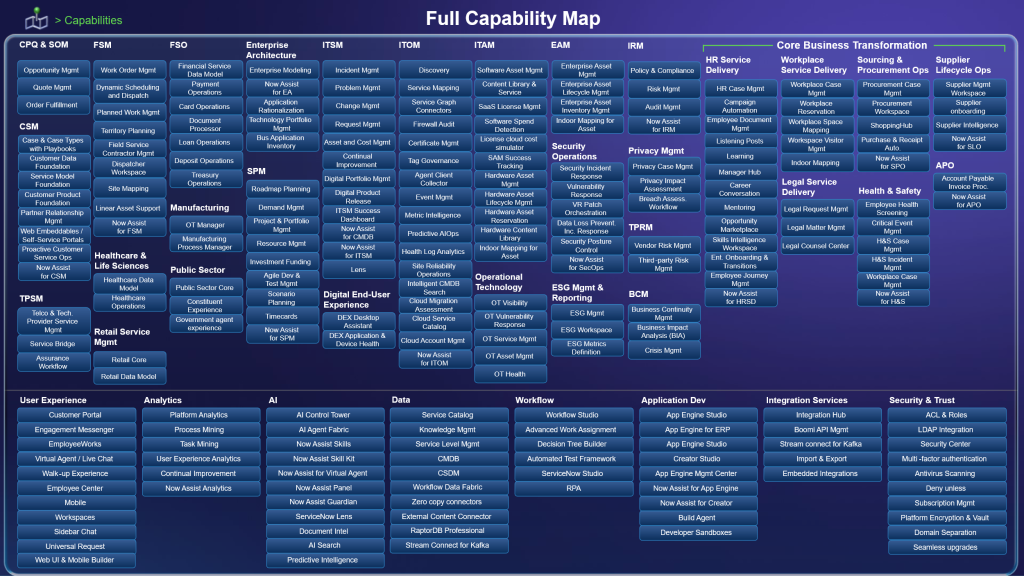
As promised, we’re coming back to the topic of choosing a specialization. Let’s look at the diagram below (Fig. 1), which shows the capabilities of ServiceNow. We won’t analyze it, but it’s worth realizing that whether you’re a developer, a consultant, or a Project Manager, at some point, ServiceNow stops being a uniform platform and becomes too big to know in its full depth. That’s when the need to choose a module specialization arises.
Many of these areas offer the option of taking CIS (Certified Implementation Specialist) exams, which confirm knowledge and the ability to work skilfully in that area. Such certificates are often required by employers, and combined with experience, they are a good pass into the job you’re after.
A few observations on how specialization works in practice:
- Knowing one module deeply opens the path to others faster than learning everything a bit at a time. Platform patterns repeat, so someone deeply rooted in ITSM picks up HRSD much faster than someone who has never gotten deep into any module. Specialization doesn’t close doors.
- A client looking for just anyone to configure forms will find many candidates. A client looking for someone who can design a full HRSD architecture with SAP SuccessFactors and Workday integrations will find few. The market pays for depth, not breadth.
- A few of the most highly regarded specialists I know have changed specialization once or twice in their careers. The market changes, the platform changes, and interests change. What matters is that the change is conscious, not accidental. Specialization is not a choice for life.
The best specialization is one that combines two elements: market demand and your genuine interest. You can spend a year being an expert in something the market values, but which doesn’t excite you. Long-term, that doesn’t work.
How to choose your path
A few questions that help you find the right direction. There are no correct answers – only answers that are right for you.
- Do I prefer to solve problems on my own (code, configuration), or together with others (workshops, consulting, working with the client)?
- Am I drawn to working with people and to communication, or do I prefer strictly technical work?
- What’s my starting point? A technical education or programming experience points toward a developer or admin. Experience in ITSM, HR, or another business area opens the consulting or process path.
- Do I want to work for a partner/implementation firm (fast pace, varied projects and industries) or directly for a client in-house (deeper knowledge of one platform, greater stability)?
- Am I interested in a technical specialization, or am I more drawn to a management, architecture, or product role?
- Do I want to be an expert in one niche, or do I prefer to combine perspectives and move along the border between technology and business?
Partner or client – two different worlds
One of the most important – and most often overlooked – dimensions of a career decision in ServiceNow is the choice between working for a partner/implementation firm and working directly for a client (so-called in-house). This isn’t a matter of prestige or pay – these are fundamentally different modes of work that suit different personalities and expectations.
Working for a partner/implementation firm
ServiceNow partners, such as Sii, deliver implementations for many different clients. Working at a partner means a fast pace, a broad diversity of projects and industries, intensive learning (especially early in your career), and exposure to many implementation models. The downsides are deadline pressure, frequent context switches, and being less deeply rooted in a single platform. Careers at partners naturally evolve toward more complex roles: senior developer, TL, architect, consultant.
Working on the client side (in-house)
Organizations that have implemented ServiceNow often hire their own specialists – administrators, developers, product owners – who develop and maintain the platform from within. Working in-house means deeper knowledge of one instance and its business context, greater stability, and influence over the direction of the platform. The downside can be fewer varied projects, which slows the pace of learning. This is often a good choice for people who value context, impact, and stability over project dynamism.
In practice, many people move between these paths. They start at a partner, build broad knowledge, and move to an in-house position – or the other way around: they leave the organization for a consulting firm in order to accelerate their growth. Both roads can lead to expert-level roles.
How to enter the ecosystem – entry paths from different starting points
There is no single right path into ServiceNow. In this ecosystem, I’ve met people with a programming background, from IT support, from HR, from accounting, from the military, and from hospitality. The platform is broad enough that it has a place for different profiles, provided that someone is aware of where to start.
English is an absolute must. All of the official ServiceNow documentation, every certification exam, most of the resources in Now Learning, and practically the entire SNDevs / ServiceNow Community are in English. Working with international clients – and most in this ecosystem are international – also requires fluent communication in English. Without it, you don’t have access to the full ecosystem.
Entry from the technical side (developer, admin)
- Start with Now Learning – ServiceNow’s educational platform with free paths for beginners.
- Get a Personal Developer Instance (PDI) – a free instance for learning and practice, available to anyone.
- Aim for the CSA (Certified System Administrator) certificate as the first step. It’s the gateway to the certification ecosystem.
- Next step: the CAD (Certified Application Developer) certificate, if you’re heading in a development direction.
- Build a portfolio on your PDI – finished examples, custom applications, documentation of decisions.
- Join the community – the ServiceNow Community is a place where you can ask a question, find solutions to specific problems, and observe what experienced specialists are doing.
Entry from the process side (consultant, BA)
- Start by understanding ITIL 4 – it’s the language spoken by most enterprise clients using ServiceNow.
- Supplement with Now Learning for the module that interests you (ITSM, HRSD, CSM).
- Aim for the CIS certificate for your chosen module, because this signals your specialization and opens doors to recruitment conversations.
- Look for a role at implementation firms as a junior consultant or BA – it’s the fastest path to hands-on experience on different projects.
Entry tied to a change of industry
- Think about whether there is something transferable you can bring into ServiceNow. For example, experience in HR opens a path to HRSD, experience in IT support opens a path to ITSM, and experience in customer service opens a path to CSM.
- Combine learning the platform with learning the process framework for the module you’ve chosen.
- Certificates are particularly important here, because they confirm platform knowledge at a stage when you don’t yet have project experience.
- Consider getting your first experience on the client side (in-house) rather than at an implementation firm. It’s easier to get in when an organization is already using the platform and is looking for someone to maintain it.
One piece of advice I give to every person entering the ecosystem: don’t wait for perfect preparation. The PDI is free, Now Learning is free, and the first certification costs less than one online course. Start, get your first experience on your own instance, and then start talking about work.
Sii x ServiceNow
With the cloud-based ServiceNow AI platform, we automate processes and facilitate the work of departments to increase productivity within entire organizations.
ServiceNow offeringSummary
ServiceNow is not a job title – it’s an ecosystem in which you can build a long-term, specialist career in many ways. Administrator, developer, QA engineer, architect, consultant, BA, PM, product owner – each of these roles has its place, its requirements, and its growth path.
A few things worth remembering:
- Entry is possible from many starting points – technical, process, and business.
- Every role calls for a conscious module specialization, and the sooner you understand that, the better.
- The most highly valued people are those who combine a technical perspective with a process or business one.
- Certificates are useful as signals of competence, but they don’t replace project experience.
- Choosing a specialization isn’t a decision for life, but it should be conscious, not accidental.
- English is a necessary condition – the documentation, the certificates, and most of the clients are English-speaking.
- The community (ServiceNow Community) is one of the most valuable resources, both for learning and for building your professional visibility.
From my experience: the people who thrive in this ecosystem combine two traits. First, genuine curiosity about the platform and the processes it supports. Second, the ability to communicate clearly: with the client, with the team, with the business. Technology can be learned; curiosity and communication – much less easily.
ServiceNow is a platform that changes every six months and will keep changing. A career in this ecosystem is a commitment to continuous learning, and for the right person, that is exactly its greatest strength.













Leave a comment