























Durable value in artificial intelligence forms around bottlenecks – and the market is already pricing some of them for perfection.
By Maciej B. Owczarek
Levi Strauss arrived in San Francisco in 1853 to sell dry goods. He left his name on the trousers worn by the men who dug for gold, and made a fortune considerably more durable than most of theirs. The lesson has been repeated so often that it has hardened into a cliché: in a gold rush, sell shovels.
In artificial intelligence, the cliché needs sharpening. Everyone can name the new gold – chatbots, copilots, agents, synthetic media, automated analysts. The harder question is who controls the scarce inputs without which none of it moves. The fashionable answer, Nvidia, is merely the first line of a longer list – one that runs through silicon, power, and data centers down to the unglamorous plumbing of orchestration, evaluation, and governance, where the more durable enterprise moats are likely to form.
An old idea at the planetary scale
Listen to the current boom for long enough, and you might conclude that intelligence was invented somewhere between ChatGPT and a board presentation. It was not. Neural networks date back to the perceptron of the 1950s, and machine learning has been quietly earning its keep in medicine, finance, and industry for decades.
I have a personal reason to resent the amnesia. In 2010, as a student at Wrocław University of Technology, I wrote a master’s thesis on neural networks for detecting breast cancer in mammography images. The classifiers worked. What they lacked was not intelligence but scale: compute, data, and a market prepared to pay attention.
The moment the field crossed a line, for me, came in March 2016, when AlphaGo beat Lee Sedol 4-1 in Seoul. I set an alarm for 4 a.m. to watch the games live. Go players had long called their game the holy grail of AI – the search space is too vast for brute force – and Move 37 of the second game, strange and almost rude to human intuition, settled the argument. The machine had found a move we had never taught ourselves to see. (The 2017 documentary AlphaGo remains worth an evening; the full version is on YouTube.)
Large language models are a different beast, but the lesson carries over. An LLM is, at heart, a network trained to predict the next fragment of text – a trick that sounds trivial and is not, since prediction forces the model to absorb grammar, facts, style, and a good deal of how the world fits together. The Transformer architecture of 2017 made it practical at scale.
What has changed since is the economics. Public estimates put GPT-4-class training runs in the tens or hundreds of millions of dollars, and Epoch AI reckons frontier training costs have been rising two to three times a year, with billion-dollar runs plausible by 2027. Using the models, meanwhile, gets cheaper at a startling pace: Stanford’s AI Index reports that the cost of querying a GPT-3.5-level system fell from about $20 per million tokens in late 2022 to 7 cents two years later – a drop of more than 280 times.
Training the frontier grows brutally expensive while yesterday’s capability turns cheap and ordinary. Much of the market’s tension follows from that single fact.
Where the picks are
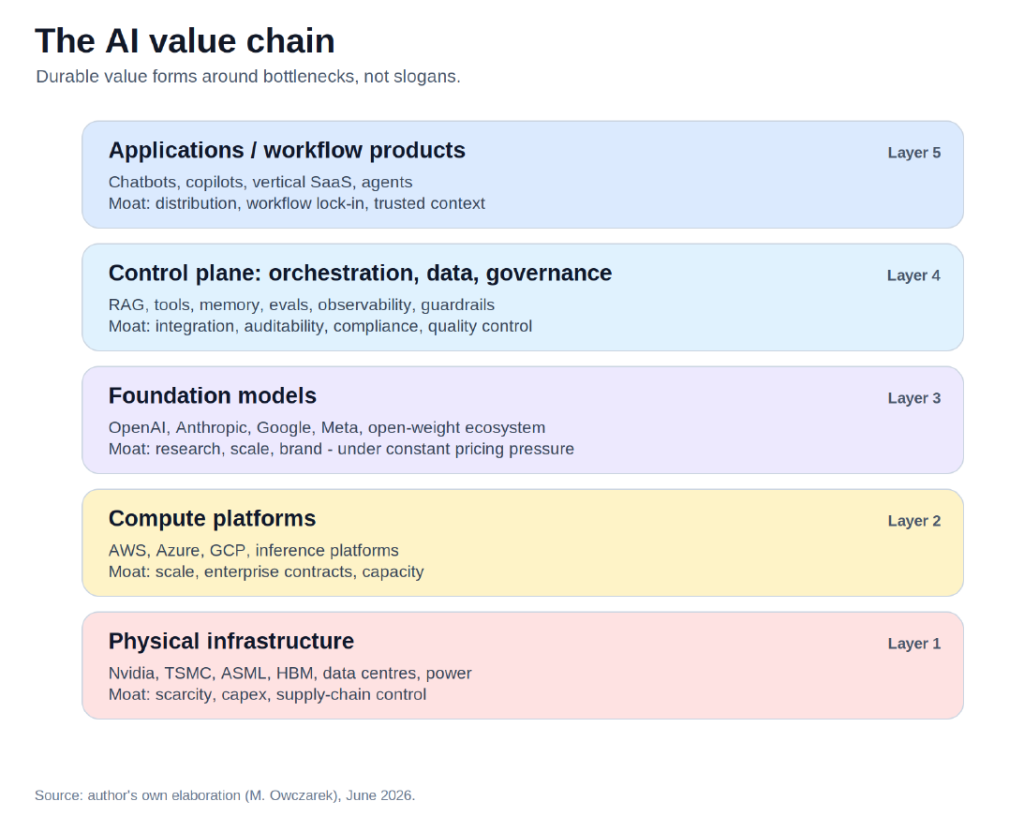
Think of AI as a layered market. At the top sit the applications: chatbots, copilots, vertical software, and agentic workflows.
It is the loudest layer and the easiest to fake. A weekend wrapper around someone else’s API can resemble a startup right up to the moment a user asks what remains once every competitor can call the same model. Cursor, Perplexity, and Harvey earned their positions by adding workflow, context, trust, or distribution; the test worth applying to the rest is whether a rival with the same model access could rebuild the product by Monday.
The more defensible ground sits one layer down, in what might be called the control plane: retrieval, permissions, memory, evaluation, monitoring, cost and latency control, audit trails, guardrails. None of it makes headlines, but the money has started to move. Datadog has pushed LLM observability into its core product. CoreWeave paid a reported $1.7bn last year for Weights & Biases, whose business is tracking and evaluating models – a compute landlord buying the metering equipment.
Regulation is the accelerant. Brussels has just deferred most of the EU AI Act’s high-risk obligations from August 2026 to the end of 2027, in part because the standards and tooling needed to comply do not yet exist at scale; the deferral is an 18-month gift to whoever builds them. Banks have treated models as governed risks since the Federal Reserve’s SR 11-7 guidance of 2011, and AI multiplies that discipline rather than replacing it.
Anyone who has built data-quality or control systems inside a large bank will recognize the pattern: the model demo takes a week; the arguments about who owns the control, where the audit trail lives, and which committee signs off take a year. That year is the most. Nobody in a regulated institution asks whether the model can draft a paragraph. They ask who approved it, what data it saw, how it is monitored, and who answers when it is wrong – and those questions arrive with purchase-order numbers attached.
A thesis that cannot fail is merely a mood, so here is the falsifiable version of mine:
By the end of 2028, spending on evaluating, monitoring, and governing AI systems in regulated industries will be growing faster than spending on the models themselves.
If that layer is instead absorbed into free features of the hyperscalers’ platforms, this article’s central claim will have been wrong – and the results of Datadog and its peers will show it.
Below the control plane sit the foundation models: OpenAI, Anthropic, Google, Meta, and the open-weight ecosystem. The moat – talent, research, compute, brand – is real, and so is the erosion. Distillation, quantization, and open-weight models keep repackaging yesterday’s frontier at a fraction of the price; a lab can spend a fortune on a training run and watch a smaller model do most of the same job within six months.
Then come the cloud platforms, and at the bottom the physical infrastructure: Nvidia, TSMC, ASML, high-bandwidth memory, data centers, and power. These bottlenecks are the hardest to copy. NVIDIA’s revenue in the fiscal year to January 2026 reached $215.9bn, and in the following quarter, its data-center division alone took in $75.2bn – more than Goldman Sachs earns in a year. That is what selling picks looks like when the whole world starts digging at once.
The Cisco problem
The awkward precedent is Cisco, which sold equipment the internet genuinely needed – and whose shares still took two decades to reclaim their 2000 peak once investors had extrapolated demand a few years too far. A real bottleneck can still be overpriced.
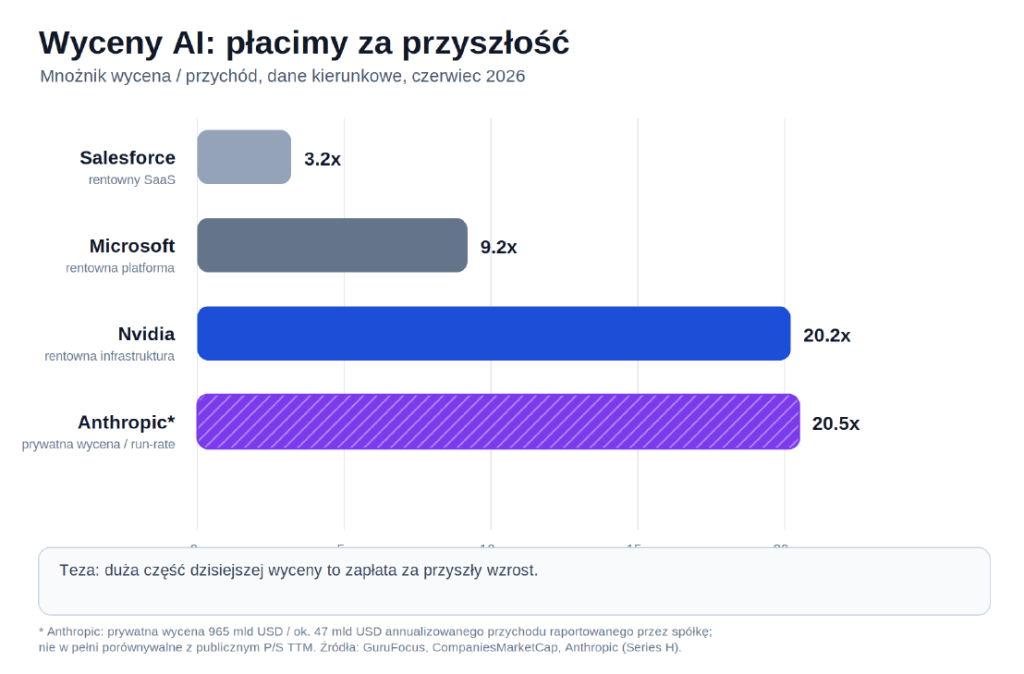
On mid-June figures, Salesforce trades at just over three times revenue, Microsoft at about nine, and Nvidia at 20. Anthropic’s $965bn private valuation implies roughly the same multiple of the $47bn annualized run-rate the company disclosed alongside the round. The comparison flatters no one’s precision – a private valuation over a run-rate is not a public company’s audited price-to-sales ratio, which is why the bar is hatched – but the direction is clear enough: a large part of today’s price is a payment for tomorrow.
That is rational if tomorrow arrives on schedule. It is expensive if growth slows, margins compress, energy becomes the binding constraint, or open models keep dragging prices down.
The investment slogan, therefore, needs an amendment. Not “buy the shovel seller”, but:
Find the bottleneck, then ask whether the price already assumes perfection.
Decoration is not a business
One warning deserves to be blunter. Many AI applications are not weak because they use someone else’s model; they are weak because they add no judgment, no workflow, and no accountability. If four products all paste a CV into an LLM and ask for a better version, the model is the product, and the application is decoration – and decoration tends to be monetized with overclaiming, opaque pricing, and dark patterns.
The US Federal Trade Commission’s first AI-marketing sweep, Operation AI Comply, supplied the emblematic case: DoNotPay, which sold itself as “the world’s first robot lawyer”, settled with the regulator in 2025 over claims that its product could substitute for one – having never tested whether it could, nor employed a lawyer to check. The objection was not that the company used AI. It was the decoration that made promises the product did not keep.
The application companies worth owning will look different – distribution, proprietary data, a regulated workflow, and a habit users will not break. They will not simply ask the model for an answer; they will make the answer usable inside a real process.

Project Management & PMO
Get end-to-end support for project management – from outsourcing experienced Project Managers and PMO experts, through project consulting and audits, to PMO as a Service
PMO offeringThe lesson of dark fiber
The dotcom comparison is useful only in full. Bubbles are real: infrastructure sellers can be overpriced, demand can be pulled forward, and investors can pay for a future that arrives later, smaller, or somewhere else entirely. Yet the revolution beneath the bubble was real, too. The internet did not disappear after 2000; it became a boring infrastructure, and then it changed everything. Even the overbuilding mattered – dark fiber looked like pure waste after the telecoms bust, until cheap surplus bandwidth made streaming and cloud computing possible.
AI will probably rhyme, and if forced off the fence, I will say where: I expect the first serious correction to land in the model layer, where pricing power is weakest, rather than in the physical one, where scarcity is real. Data centers may change hands at a discount; the fabs will not.
Meanwhile, the most plausible happy ending remains the least cinematic: LLMs become ordinary, embedded in spreadsheets, inboxes, and development tools, used without comment the way electricity is. They will remain levers rather than autopilots, amplifying the judgment – or the mediocrity – of whoever holds them.
The best business in a gold rush is rarely the one holding the shiniest pick. It is the one selling something every serious digger needs – at a price the next cycle can still bear.
Sources and further reading
- Stanford HAI, AI Index Report 2025 – inference cost decline and broader AI market data
- Epoch AI, How much does it cost to train frontier AI models?
- NVIDIA Investor Relations – results for the fiscal year to January 2026 and Q1 FY2027
- Goldman Sachs, 2025 Full Year Earnings Results – net revenues of $58.3bn
- GuruFocus – P/S ratio data for Nvidia and Microsoft
- CompaniesMarketCap – Salesforce P/S ratio data
- Anthropic, Series H funding announcement – private valuation and reported run-rate revenue
- CoreWeave, CoreWeave Completes Acquisition of Weights & Biases (May 2025)
- Council of the EU, Artificial Intelligence: Council and Parliament agree to simplify and streamline rules (May 2026)
- US Federal Trade Commission, FTC Finalizes Order with DoNotPay (February 2025)
- Federal Reserve, SR 11-7: Guidance on Model Risk Management
- Vaswani et al., Attention Is All You Need
- Documentary AlphaGo (2017), dir. Greg Kohs













Leave a comment