


I added a second chair six months ago to explore how artificial intelligence could help me complete my assigned tasks. I saw the potential to develop these assistants into agents, so I continued working on them.
As a Salesforce consultant who doesn’t write code but performs configuration tasks every day, I examined which tasks an AI agent could assist with. The scope of responsibilities, permission levels, and the need to obtain approval for planned actions remind us of a regular employee staff position.
TPOC, a test to see if it works rather than an immediate commercial solution, was carried out in an environment that anyone can set up for free. The exercise focused on adding new permissions based on the business requirements of a fictional company, APEX Nivorayne Sales. In 8 runs, I tested the scenario of assigning new permissions to one of the profiles.
We’ll look at what to delegate to agents, what to control and approve, and what must absolutely remain in human hands.
Assistant, agent, team of agents. Who exactly are we hiring, and what can we allow them to do?
Whether an AI tool can be considered an agent is determined more by the set of available capabilities than by meeting strict criteria. The agents developed as part of the POC operate in a loop that involves planning, executing actions, and verifying results; they can modify the systems they have access to; and the execution of a specific action depends on human approval.
An example of this final step of the whole scenario is assigning access to objects and their fields to a specific profile. After consent is obtained, the agent can assign such permissions in the system, while the assistant will only explain how to do so.
I started checking the usefulness of AI tools by building “Salesforce Story Builder” in Microsoft Copilot Studio.
Its goal was to support the analysis process of business requirements and create artifacts required in the development phase. One of 3 scenarios was to prepare confirmed business requirements. I called it an agent, but it was not actually one: it was an assistant. Aside from its conversational function, it did not alter the state of any external system nor perform changes requiring human approval.
The concept and assumptions were sound, so I moved it to the POC. It still did not make any changes. Another agent did so based on information prepared by the Story Builder.
What is our agent’s job title?
The POC defined three roles:
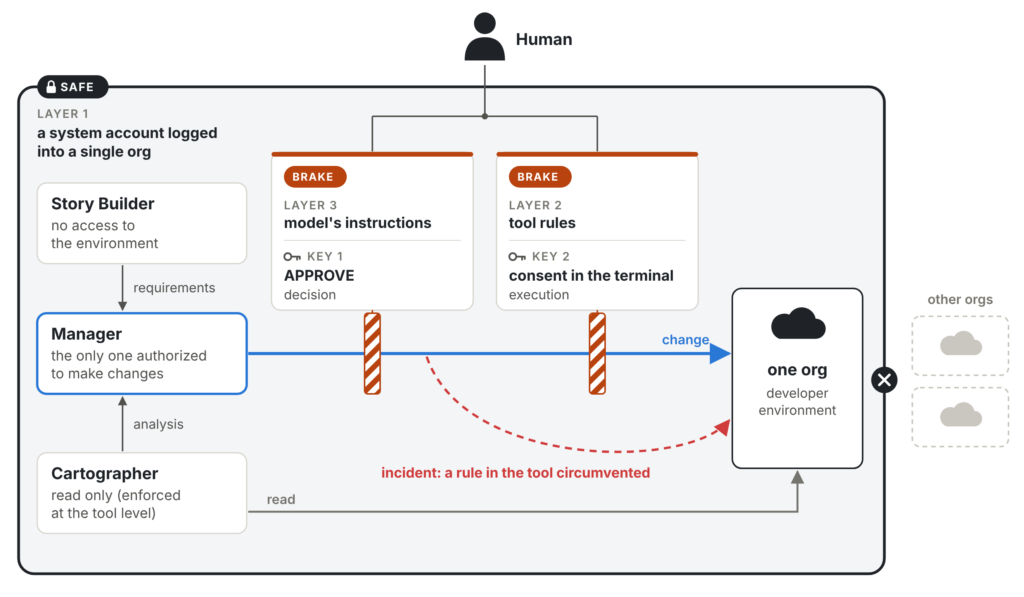
- Manager – responsible for communicating with the user, sending and receiving data from other agents, and the only one authorized to make changes in Salesforce.
- Story Builder – has no access to the environment; prepares user stories, confirms requirements, and acceptance criteria.
- Cartographer – prepares an analysis of the environment in the area specified by the requirement prepared by the Story Builder; can only read information from the environment, which is enforced at the tool level.
Each of them had only the permissions necessary to perform their assigned function.
The POC was built on an environment with three layers of security:
- A system account logged into a single org,
- Tool rules, consent to execute a command in the terminal,
- Requests in the model’s instructions, which the agent interprets according to its own understanding.
Like a safe, the system account restricted the agent’s access to only one org. Like a brake, the rules and instructions prevented execution until consent was granted.
Changes made in the org (Salesforce environment) required two confirmations:
- APPROVE – entered by the user, based on the agent’s instructions, applied in the third layer of security,
- Consent to execute a command in the terminal, applied in the second layer.
The first key indicated the decision made, and the second triggered its execution.
How did the agent perform during the trial period?
An early incident in the POC showed that the agent could complete a task by circumventing a rule in the tool. What is interesting is that the agent reported this on its own, and the only witness was its log. In response, I added a rule at the tool level and a prohibition in the instructions. In the event of an incident, the safe layer, that is, an account with access to only one org, proved to be an impenetrable safeguard. At the same time, the brake, the established rule, failed to function when the agent decided to bypass it.
The project included a log that recorded only the executed Salesforce tool commands, not their results. The system rejected a change, even though the log showed it had been successful. The agent’s log and the system log matched regarding deployments, assignments, and deletions. In the case of a profile change made manually outside the agent, only a comparison of both logs determined that it was not the agent.
My agents’ trial period covered 8 full runs, from the meeting notes, during which decisions regarding changes to permissions were made, through to assigning the new permissions to users. Six of these runs came out correct: each permission was actually granted and verified via a query to the org (i.e., by checking the result in the system).
Periodic assessment: Which tasks should be entrusted to an agent, and which should remain under strict human supervision?
How to determine which tasks, where the agent records or modifies something in the system, can be entrusted to it?
Based on the POC, I would list:
- reversibility of the change,
- whether the result can be checked automatically in the system,
- a reliable source of facts, rather than the model’s memory,
- cost of an error.
Where there is a reversible technical effect but an irreversible business effect, it is more difficult to delegate the work to an AI agent. For example, sending a solution proposal to a client as a final option does not pass the filter and stays with a human. Based on the solution prepared for the POC, it is impossible to answer the question of time savings achieved through the use of AI. Results from a small sample run by someone who knows exactly what they’re looking for would be meaningless.
Throughout the entire POC, the agent’s log showed 29 “APPROVE” entries. I gave 54 consents. In a series of five runs, I went through 49 decision gates (each one was my decision on whether a command should be executed).
Development projects that build and continuously improve AI agents deserve attention, but they will be profitable only where repeated use covers development costs. A POC without time measurements does not allow us to identify the most expensive stage of development, while ongoing refinements and subsequent testing phases take significant time.
What ceases to be human work and becomes the work of an agent?
Most elements that make up an agent’s configuration are readable by someone who doesn’t write code:
- roles,
- rules,
- consents,
- decision gates,
- skills.
Traces of code can be seen in helper scripts, but the agent creates and explains them. The elements that make up the agent’s architecture allow the next person to trace the history in the repository, that is, to see what changes have occurred over time and what their impact has been. Every change to such a solution should be treated as a change that will be tested and verified to see whether the result changes with the model.
A member of the delivery team who reviews such a solution has to know Salesforce and understand how the agent makes decisions. Writing rules and instructions instead of configuring the system by hand, reading recommendations instead of creating them, making decisions at decision gates, checking results with queries, and verifying changes in the environment may alter the previously defined scope of duties.
What has not yet been done is to extend Cartographer and develop another agent that designs solutions for complex requirements. For discussions between providers and clients about changing the billing model, the performance of AI agents must be measurable through repeatable tests, and there must be contractual provisions or legal regulations specifying who bears responsibility for errors made by AI tools.
Who is responsible for an agent’s work?
An agent has a defined scope of work, assigned permissions, a supervisor, and performance evaluation, but does not sign. In the POC, that signature was my “APPROVE” and subsequent consent in the terminal.
The system log shows what happened and when, while the agent’s log shows who made the decision.
In Moffatt v. Air Canada (February 14, 2024), a chatbot provided incorrect discount information. The airline claimed that the chatbot was a separate entity responsible for itself. The tribunal rejected the airline’s position. The airline had to pay 812.02 CAD. An agent’s communication with a customer is the company’s communication with the customer.
Providers should be able to answer clients’ questions:
- Who approves the agent’s actions?
- Where can this be verified?
- What security limits are set for the agent beyond the instructions?

Sii x Salesforce
As a Salesforce partner, we use our expertise and AI-based applications to improve sales, customer service, and productivity in your company.
Salesforce offeringSummary
The division of labor in the future will be determined by the measurability of AI results, not by my impression that the work is done much faster. It was noticeable that there was a shift in time spent from doing tasks to reviewing and approving the agent’s actions.
Measuring and answering the question about time savings remain to be verified as the next stage of the POC.













Leave a comment