






















Who is a Solution Architect and what does their work look like at Sii?
30.11.2025
Discover the role of a Solution Architect at Sii – who they are, how they work, and why Sii is the perfect place for IT Solution Architects who want to make a real impact on digital transformation and technology projects.
The role of a Solution Architect goes far beyond system design – it’s about bridging the gap between business and technology, making strategic decisions, and ensuring that IT solutions truly deliver value.
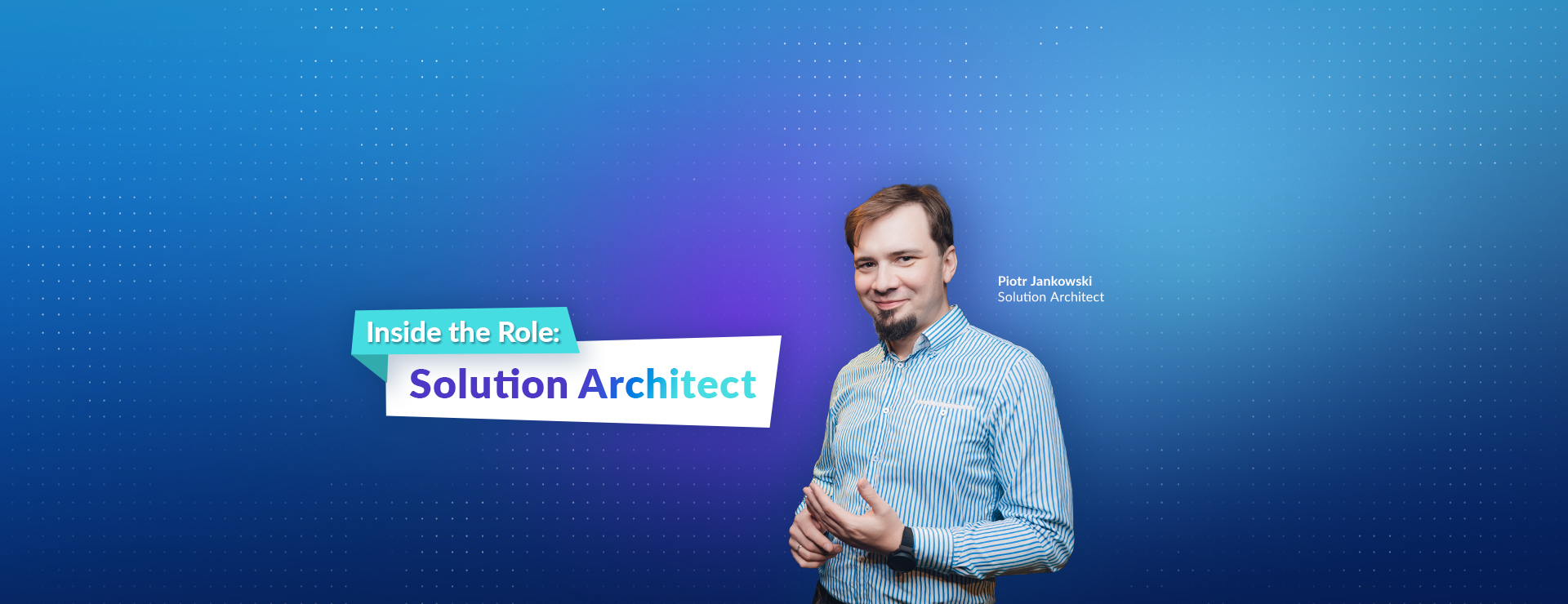
Piotr Jankowski, a Solution Architect at Sii Poland, shares what this job looks like in practice, what challenges come with it, and why it’s so rewarding. If you’d like to see our current openings for Solution Architects, click here.
Who exactly is a Solution Architect?
How would you describe what a Solution Architect does in just a few sentences?
A Solution Architect designs system structures that meet both business and technical needs while ensuring compliance with regulations and security standards. They make key architectural decisions and maintain consistency across the entire IT ecosystem. Their goal is to create scalable, transparent, and future-proof systems – without having to rewrite the code every six months.
People often say that Solution Architects connect business and technology. What does that mean in practice?
It means understanding both business objectives and technical constraints. A Solution Architect translates business requirements into system language – and vice versa – explaining to technical teams why something should work a certain way. This ensures better architectural decisions and smoother collaboration between teams.
How does a day in the life of a Solution Architect at Sii look like?
Every day looks a bit different, as the role blends conceptual, design, and communication work. Mornings often start with project meetings to stay aligned on progress. Then comes time for designing architectures, selecting technologies, and ensuring alignment with business goals. Solution Architects also support developers during implementation, oversee system consistency, and often spend afternoons meeting with clients or business stakeholders.
What personal qualities help or hinder in this role?
Curiosity and humility are key. Curiosity drives you to understand how and why things work, while humility allows you to admit mistakes and learn from others. Systems thinking and the ability to see the bigger picture are crucial, as is patience – sometimes you need to wait for the full context.
What doesn’t help? Excessive perfectionism and micromanagement. Looking for the perfect solution can stall a project indefinitely. Sometimes, “good enough” is exactly what’s needed to move forward. An architect who gets involved in every detail of implementation ends up blocking the team instead of supporting it.
From concept to implementation – the Solution Architect’s process
How does the process of building a solution look from start to finish?
It begins with understanding the business context and identifying architectural drivers – factors like security, scalability, testability, or deployment time. Then comes analysis of possible approaches, evaluation of trade-offs, and design decisions. After implementation, the architect monitors the results and adapts the solution as business needs evolve.
Which technical decisions belong to the Solution Architect, and which to the development team?
The architect handles conceptual decisions – architecture design, technology choices, integration methods – while the development team owns the implementation details within that framework. What matters most is making the right decisions at the right time, with full business context.
How do you connect business needs with technological capabilities?
It always starts with understanding the business goals and constraints. From there, I define key architectural drivers and select technologies that best support them. Technology should serve the business, not the other way around.
How do you assess the quality of a system’s architecture?
It’s all about context. A well-designed system is one that meets its goals, not just one that looks good on a diagram. Metrics and documentation – such as Architecture Decision Records (ADRs)- help with evaluation.
What tools and methods support you in your daily work as a Solution Architect?
I rely on methodologies that support decision-making, such as architectural drivers and measurable metrics. Building PoCs (proofs of concept) is also very helpful before full implementation. Conceptual work often involves Event Storming, Domain-Driven Design (DDD), C4 modeling, ADR documentation, and notation standards like UML or BPMN. Over the years, I’ve also developed my own templates and tools.
Which technologies have the greatest impact on the work of a Solution Architect today?
Public cloud (AWS, Microsoft Azure, Google Cloud), microservices, containerization, DevOps, and AI – all these define modern system architecture and shape IT transformation in organizations today.
Do Solution Architects still code?
It depends on the project. Sometimes I build prototypes or key components; other times, I focus on advisory work, code reviews, and supporting teams. The right balance between coding and strategizing is key. Too much coding leaves no time for strategic thinking, too little and you lose touch with implementation realities.
Challenges and mistakes
What mistakes do beginner Solution Architects often make?
They tend to make decisions too early, before understanding the full context. They also forget to document their decisions, making them hard to justify later. And finally, they expect the architecture to “emerge on its own,” which usually leads to chaos.
And what if the client expects more than technology can deliver?
Then communication is key. We analyze priorities together – what’s essential, what can wait, and what can be refined. Sometimes that means compromise; other times, a complete change of approach.
The path to becoming a Solution Architect
What skills are essential at the start, and which can be developed later?
I started as a Java Developer and Technical Consultant. Over time, I found myself bridging business and technology more often, which naturally led me into the Solution Architect role.
You can’t become a Solution Architect without strong technical foundations – programming, design patterns, system architectures, databases. Quick learning is just as important, since technology changes fast. Systemic and analytical thinking also help a lot.
Communication skills can always be improved with experience. At Sii, you gain exposure to real projects across industries and scales, with access to mentoring for juniors and knowledge-sharing opportunities for senior experts.
What advice would you give to someone aspiring to this career?
Start by building solid technical foundations – understand systems, databases, networks, and design patterns. Think systemically: ask why certain decisions were made and what long-term impact they have. Develop your communication skills, architects must explain complex concepts to both business and technical audiences. And don’t be afraid to make mistakes – every architect does. The key is to learn from them.
Can developers or project managers become Solution Architects?
Absolutely. Developers usually take the most natural path, but project managers can to – each just needs to fill different knowledge gaps. Developers should strengthen business and communication skills, while project managers should deepen their technical expertise.
Why Sii is a great place for Solution Architects
At Sii, Solution Architects are not detached from teams. Unlike in some companies where architecture is imposed top-down, here it’s a collaborative process built on understanding, teamwork, and adaptability. Architects are involved from day one, shaping projects, technology choices, and development directions.
Because of the project diversity, from startups to enterprises, across industries and technologies architects at Sii grow faster than in product-based companies.
What kind of projects inspire you the most?
The ones where architecture isn’t a ready-made template but a response to specific business goals, technical constraints, and user needs. I enjoy challenges that require balancing multiple perspectives – security, scalability, time-to-market, and truly understanding why the system exists.
How does collaboration with development and analysis teams look like at Sii?
It’s all about shared understanding of goals and structure. When every developer, tester, and analyst knows what we’re building and why, communication becomes simpler and decisions more meaningful. I don’t impose solutions, I help teams make conscious, well-timed decisions.
Working at Sii Gdańsk
What makes the Gdańsk office stand out?
Today, with remote work, location matters less than it used to – but I’d still encourage you to visit and see for yourself.
What do you appreciate most about working in Sii Gdańsk?
The positive atmosphere and openness. You can approach any team with a question or ask for feedback, no one hides behind project walls. That’s especially valuable for architects, who can draw on diverse experiences and build better solutions.
The future of the Solution Architect role
Which trends will shape this role in the coming years?
AI, LLMs, and machine learning are reshaping the IT landscape. They’re no longer optional – clients increasingly ask for AI integration or AI-powered software delivery. Automation is also becoming universal – from Infrastructure as Code to automated testing. Architects must design systems that can be fully automated and securely managed.
Security is another major focus: zero-trust and security-by-design are no longer optional add-ons but core principles. Every architectural decision must consider security from the very start.
Is AI a threat to Solution Architects?
Not at all. AI is a support, not a replacement. I use AI tools daily for code analysis, documentation, and prototyping. They speed up routine tasks and let me focus on strategic thinking.
But AI won’t replace human touch. It can’t understand business context, company culture, or have nuanced conversations about change. Strategic thinking, communication, and decision-making in uncertainty remain uniquely human strengths.
What makes a great Solution Architect?
A good Solution Architect knows the required technologies. A great one knows why they use them. The difference lies in communication, long-term thinking, and humility. A great architect can explain complex ideas clearly, foresee system evolution, and admit when they’re wrong.
Want to shape modern IT systems and influence technology choices for real clients?
This is your chance to join Sii, work across industries, and grow as a Solution Architect. Check our current job offers for Solution Architects.


