























The Dashboard is green, but the Project Manager can’t sleep. We’ve all been there: A few days before the S/4HANA go-live, the reports look perfect. Everything is tested, defects are closed, and the sign-off is ready. On paper, there is no reason to worry. And yet, there’s that persistent, gut-wrenching feeling that the system is not fully under control.
Why does “high test coverage” so often fail to translate into “actual release safety?” This is often not just a testing execution problem. Most teams are testing a lot. The real issue is that testing has become disconnected from actual business risk – especially in SAP S/4HANA environments, where complexity, integration, and change frequency are significantly higher than in traditional ERP landscapes.
In S/4HANA, even a small change in a central component (e.g., pricing logic or master data) can propagate across integrations, Fiori apps, and satellite systems, affecting downstream processes such as billing or financial postings.
Over time, I’ve seen that release issues typically do not come from a single obvious failure point. Instead, they emerge from a combination of smaller misalignments across the validation process. These misalignments consistently appear in five critical areas.
Where SAP release control actually breaks
In most SAP programs, loss of control does not happen randomly. It consistently appears in five areas:
- How scope and priorities are defined.
- How test cases reflect real business processes.
- How access and authorizations behave in QA versus production.
- How realistic and complete is the test data?
How governance and release decisions are made.
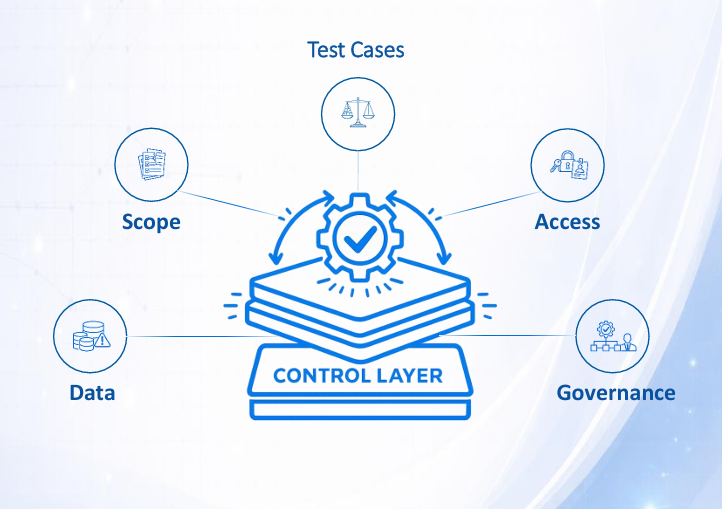
These areas sit on top of foundational elements such as transport management, environmental stability, and integration reliability, which further amplify release risk if not properly controlled. Individually, each of these looks manageable. Together, they determine whether a release is predictable or fragile.
When even one of them is weak, confidence collapses – often late in the cycle.
This is where most late-stage surprises originate.
Business scope and priorities: The “Coverage Paradox”
Scope definition is usually where the first tension appears. As release pressure increases, teams naturally try to increase regression coverage. More scenarios are added, more cases are executed, and the intention is always the same: reduce risk by checking everything.
In some cases, this leads to the Coverage Paradox: when everything becomes a priority, nothing is truly a priority. In others, insufficient coverage creates similar risk – in both cases, the core issue is a lack of prioritization based on business impact. Treating a critical “Order-to-Cash” flow for a top-tier customer with the same urgency as a minor internal reporting update dilutes the focus of your best experts.
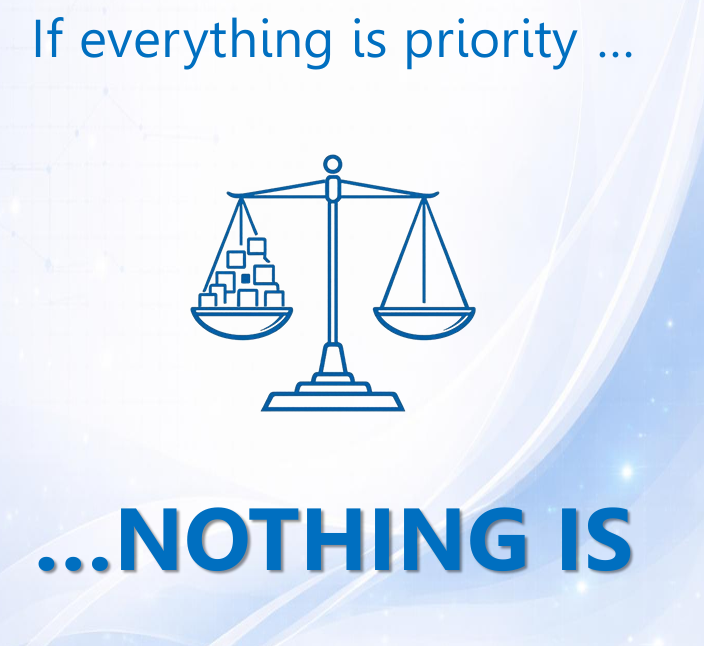
The consequence: Teams burn hundreds of hours validating low-risk features while high-impact business flows remain under-tested in realistic business scenarios and production-like conditions. This “spray and pray” approach often leads to critical post-go-live failures in the very processes that keep the company profitable. When the system fails at the loading dock or during invoice generation, the “reported test coverage” metric becomes a meaningless KPI that offers no protection against business disruption.
Test cases and the role of automation: The maintenance trap
Automation is usually introduced with a clear expectation: faster execution and better scalability. But automation itself does not improve test design; it only executes what has already been defined. If your manual test cases are outdated or focus on technical fields rather than end-to-end business logic, automation will help you reach the wrong conclusions faster. In S/4HANA, where the UI (Fiori) and underlying APIs change frequently, fragile automation becomes a liability. Many teams fall into the trap of “automating the status quo” rather than automating business risk
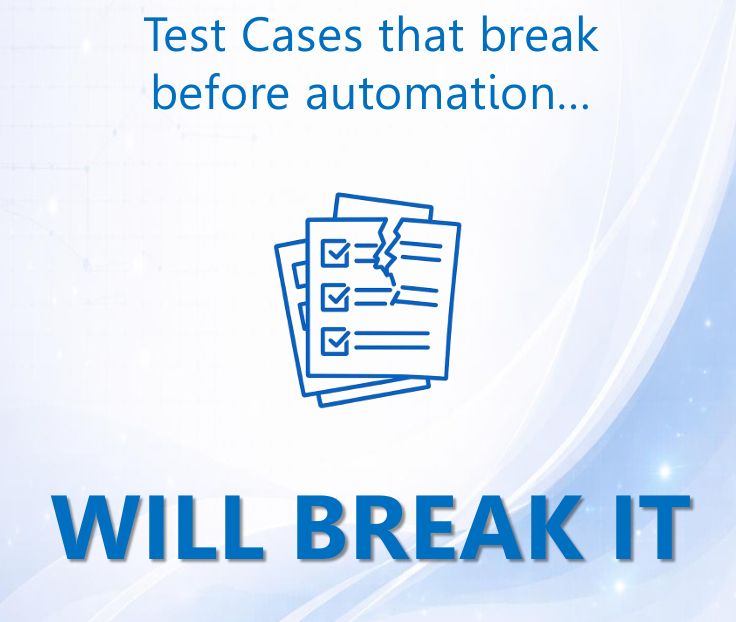
The consequence: You end up with a “maintenance trap” where the QA team spends a significant portion of their capacity maintaining and fixing automation scripts rather than analyzing system behavior. This leads to a dangerous paradox: the automation suite stays green because scripts are adjusted to remain executable, without necessarily validating the underlying business intent, while the actual business logic remains unverified. When the business process breaks during the first hour of production, the repair cost is 10 times higher than it would have been during a properly designed validation phase.
Access and authorizations: The invisible boundary
Access and authorizations are often treated as a technical configuration detail, relegated to the “Security Team.” In reality, authorizations define the boundaries of what is actually being tested. If QA environments allow broader access than production to “keep testing moving,” the system behavior is no longer comparable.
A transaction might work perfectly in a “User-Acceptance” environment where the tester has SAP_ALL, but it will fail in Production, where the actual clerk has restricted, localized roles. This is especially true for S/4HANA Fiori tiles, where visibility is tied strictly to complex catalog assignments.
The consequence: A “Success” in the QA environment becomes a “Permission Denied” error or a failed transaction in Production. This discrepancy often forces emergency, unvetted changes to security roles immediately after go-live, creating massive compliance gaps and disrupting the work of hundreds of end users. In the worst-case scenario, it halts business operations because the “Critical Path” users cannot access the new functions they were trained to use.
Test data as a hidden risk driver: The sterile lab issue
Test data is the most underestimated element of the SAP lifecycle. It is often treated as a static prerequisite – something you “copy from Prod” once a year and then forget. However, test data determines what remains invisible during validation. When datasets are simplified, “sanitized,” or manually created by developers, they remove the organic complexity of the real world.
For example, I’ve seen critical tax calculation releases pass all QA gates because they were tested on “clean” master data. But the moment they hit production, the system failed to process transactions correctly under real data conditions. Why? Because the production environment contained legacy customer records with missing ISO codes, overlapping time zones, and special characters that the “clean” test data did not include.
The consequence: Testing in a “sterile” environment provides a false sense of security. The first time the system meets real, “messy” data is in Production. This can lead to data inconsistencies, failed processing, operational disruption, stuck inbound/outbound queues, and failed financial postings, all of which are incredibly expensive and time-consuming to clean up. You aren’t just fixing a bug; you are performing surgery on your live financial records.
Governance, decision-making, and the role of AI
At some point, every SAP release stops being a testing problem and becomes a decision problem. The question shifts from “what was tested?” to “is the remaining risk acceptable for the business?”
This is where Modern Governance – and increasingly AI – comes into play. In mature organizations, AI is not a separate silo; it can support the decision-making framework by providing additional insights – but it does not replace human judgment.
AI-supported Change Impact Analysis helps identify which objects and processes are likely affected by a transport, based on dependency mapping and usage data, allowing the team to significantly reduce the scope of regression testing and focus on the most impacted areas, directing their efforts toward the 20% of the system that actually changed. AI can also identify “Data Gaps” by comparing QA data patterns to Production usage, ensuring you aren’t testing in a vacuum.
However, AI only amplifies the existing structure. If your governance is weak, AI will only help you make poorly informed decisions faster.
The consequence: Without clear governance – supported by intelligent data – decisions are made based on “gut feeling” or political pressure to meet a deadline. This lack of structured control results in “Go” decisions that ignore hidden risks. When the release fails, the fallout isn’t just technical; it’s a loss of stakeholder trust that can stall an entire digital transformation journey for years.
The missing layer: SAP Control Layer
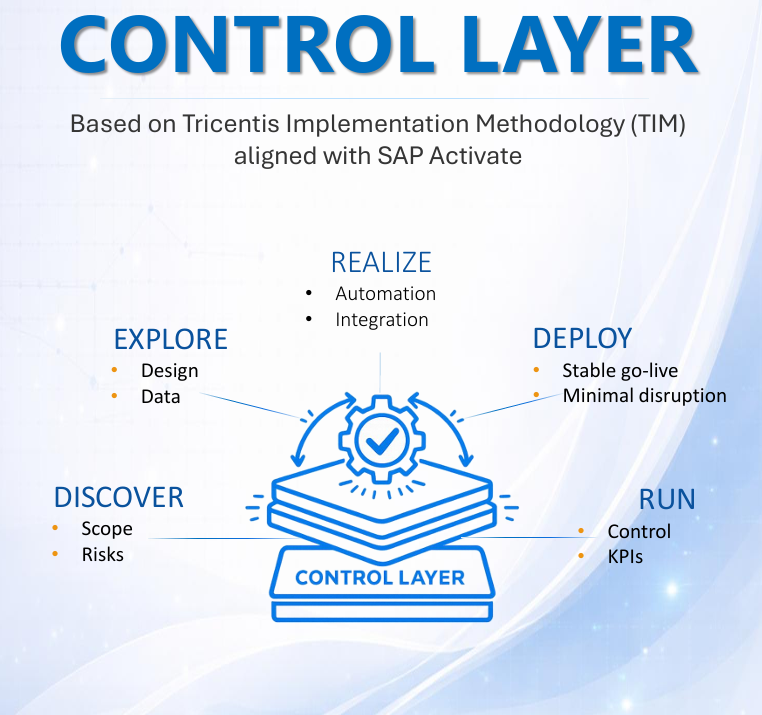
In mature SAP environments, release safety is not achieved through more testing. It is achieved through a structured control system that sits above testing itself.
This system – what we refer to as a “SAP Control Layer” – defines whether change is actually understood, validated, and safe to release.
It is built on five interconnected dimensions:
Individually, these are familiar testing topics. Together, they form the actual control system for SAP change.
When this layer is weak, releases become unpredictable — regardless of how much testing is executed.
This is where late-cycle surprises typically emerge.
Sii x Tricentis
As the largest Tricentis partner in Poland, we implement modern AI-based low-code tools to automate testing and reduce costs.
Tricentis offeringFinal thought: From volume to value
As S/4HANA continues to evolve into a more dynamic, cloud-integrated landscape, the old “Test Everything” manual approach is no longer sufficient. Complexity is not going away, and the speed of business will only increase.
Release control in this new era doesn’t come from the quantity of tests performed. It comes from the quality of the signal you get from your validation process. It comes from aligning your scope, your data, and your authorizations with the cold, hard reality of your production environment.
Because in the end, the board doesn’t care how many test cases you executed. They care if the business is still running on Monday morning.
The real question is: Were the right things tested to ensure a safe release?
If you’d like to learn more about how we at Sii apply Quality Engineering standards in SAP projects, feel free to follow our upcoming posts. You can also reach out to me directly – I’m always happy to share insights from real project experience. Contact me on LinkedIn.













Leave a comment