
























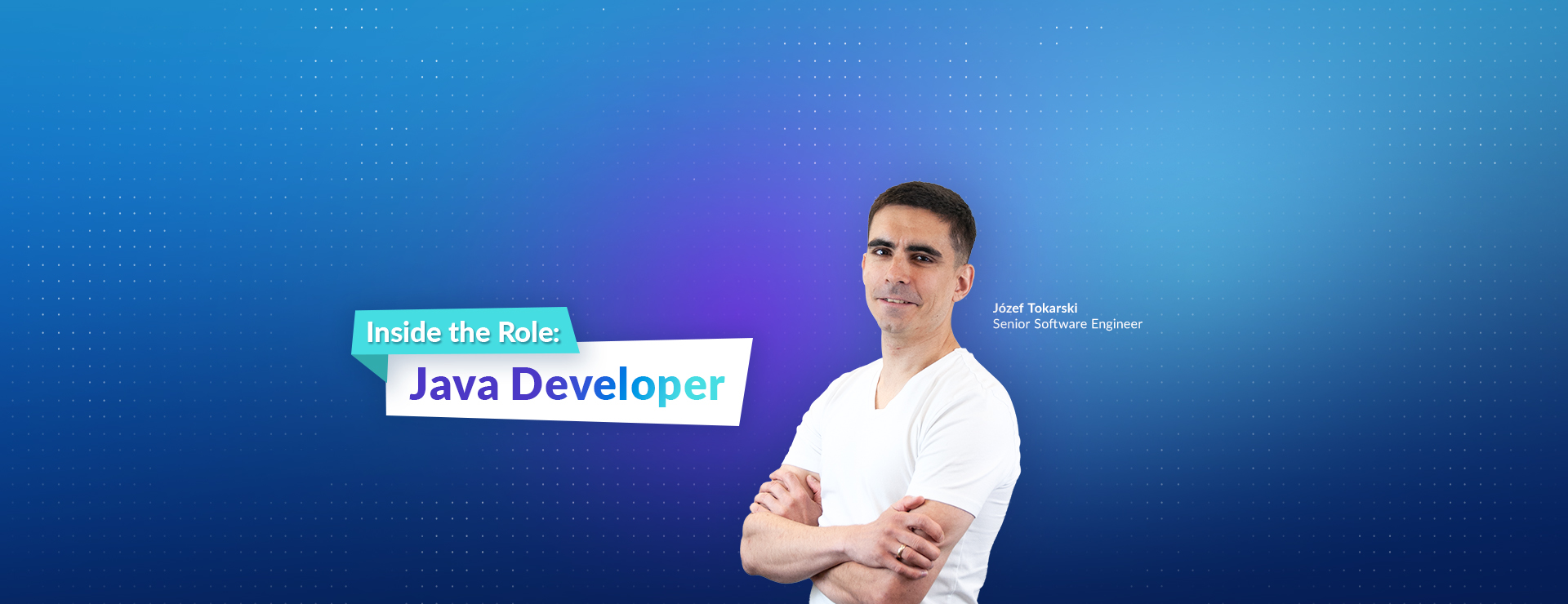
Inside the Work of a Java Developer – an Interview with a Sii Expert
11.12.2025
Do you want to program in Java, write professional code, and grow your career as a Java Developer? This article will help you discover the key aspects of working with this technology. You’ll learn about development paths and what modern employers expect.
Read our interview with Józef Tokarski, Senior Software Engineer, and an experienced Java specialist from Sii Poland. If you’d like to join our team, check the current job openings here.
The Role of a Java Developer – what this Software Developer actually does, how they create code, and which technologies they use
How would you describe the role of a Java Developer in a few sentences?
The role of a Java Developer is remarkably clear compared to many other positions in the IT industry. They build and develop applications based on the JDK platform and the entire Java ecosystem. It’s not only about writing code – it’s also working with tools, frameworks, integrations, and CI/CD processes. The term developer better reflects the modern scope of the role because Java Developers handle tasks far beyond programming alone.
How does the work of a Java Developer differ from other programming roles?
A Java Developer usually operates on a higher level of abstraction. Rather than building everything from scratch, they choose and integrate the right solutions, frameworks, and tools. It’s less about low-level knowledge and more about designing and connecting architectural components.
What does a typical day for a Java Developer look like?
The day starts with “getting into context” – diving gradually deeper until reaching full focus, when the dots connect and everything starts to make sense. Then there’s usually a short daily status meeting. The rest of the day revolves around analysis, design, and coding.
Does a Java Developer at Sii focus only on coding?
No. Pure coding is less than one-third of the job. The rest are requirements analysis, solution design, anticipating technical consequences, and proposing alternatives. A Java Developer must think broadly – more like a chess player, planning several moves ahead.
What does the process of building a Java application look like?
It depends mainly on the client’s cooperation model. Personally, I enjoy the technical kickoff the most: setting up Git repositories, adding frameworks, configuring CI/CD. It’s the moment when a Java Developer works closest to technology.
Which technologies does a Java Developer at Sii work with most often?
Primarily modern solutions: microservices, event-driven architectures (Kafka), Spring, Hibernate, Quarkus, Kubernetes, public clouds (AWS/Azure/GCP), and DevOps tools, such as GitHub Actions or GitLab CI.
What technical challenges do Java Developers face most often?
The biggest challenge is designing solutions and keeping up with the rapid evolution of the Java ecosystem. Ten years ago, people said the frontend was the domain, where a new framework appeared every week. Today, Java development is changing just as fast – with new frameworks, tools, and approaches emerging constantly.
How does collaboration within the teamwork – do you follow Scrum or something else?
Usually Scrum, although in my entire career I was part of a project fully applying Scrum only for a few months. I don’t think we should treat it too rigidly. In the end, Scrum is for people, not the other way around. If the project runs well and the team communicates effectively, the absence of one ceremony or another is not a major issue.
Junior vs Mid vs Senior Java Developer – differences in projects and assigned responsibilities
How does the work of junior, mid, and senior Java Developers differ?
Being a Senior Java Developer means being ready to take on the toughest tasks in the project – the ones requiring the most complex design or the most difficult defect analysis. It also means being able to mentor less experienced colleagues.
A Mid Java Developer works independently on medium-complexity tasks and knows how to fill knowledge gaps when needed.
To me, being a junior means having a natural curiosity for technology and an open mind. The path from junior to senior is not automatic – not everyone makes it. Observing successful careers, I noticed one common trait: even early on, these people displayed qualities typical of a senior, such as foresight, the ability to anticipate consequences, understanding how a complex system works as a whole, and critically assessing the viability of different solutions.
What distinguishes a good Java Developer from a great one?
Passion, motivation, and the right match with the project. A great Java Developer works more effectively and knows how to fully leverage their skills.
What skills are essential specifically for Java Backend Developers?
Advanced SQL and relational database knowledge, basics of computer networks, Linux, Docker, and containerization. Without these, even a skilled Java Developer may struggle with diagnosing unusual problems.
What matters most when designing backend solutions in Java?
A Java Developer must consider business requirements, scalability, data storage (relational or document-based), communication between microservices, and overall system architecture.
Career growth in IT: the Java Developer’s development path. How to gain more programming experience?
What are the most common mistakes of junior Java Developers?
Instead of talking about mistakes, I prefer to give practical advice: build your own projects, create simple web applications. It’s the best way to develop quickly as a Java Developer.
What else would you advise someone beginning as a Junior Java Developer
As I mentioned: build your own projects after hours, explore frameworks and libraries, form your own opinions, and read source code. Use AI tools but think independently. Take on responsible tasks and deliver quality.
What did your path from Junior Java Developer to your current role look like?
From the start, I took on responsible tasks, including in the CI/CD area. I’m a perfectionist – if I see something that can be improved, I must implement it. It’s not great for work-life balance, but it naturally leads to advancement.
Which skills are essential to become a mid- or senior-level Java Developer?
A broad understanding of the JDK platform: Java language (including generics), collections, exceptions, streams, date/time API, and concurrency support. Strong knowledge of patterns present in application frameworks (mainly Spring), such as dependency injection or AOP. Understanding database transaction management. Mastery of JPA and relational databases in general. Strong SQL skills. Familiarity with tools for writing unit and functional tests.
Additionally, technical interviews may include questions about pros and cons of certain patterns, libraries, or frameworks, and sometimes about their internal mechanics. You must not only know these things, but also be able to think and speak about them from different angles.
What personality traits help a Java Developer succeed?
A Java Developer must be communicative and resilient to stress. You constantly interact with analysts, stakeholders, testers, your own team, other teams, and infrastructure people. Some days this job resembles an air-traffic controller more than the stereotype of a quiet programmer. That’s why strong soft skills are essential, along with emotional intelligence – to communicate efficiently and stay motivated through difficult challenges.
Can someone at Sii grow from Junior Java Developer to Architect or Team Lead?
Yes. At Sii we have the Summer Talent Academy; selected candidates are invited for an internship, and many receive full-time job offers afterward. Every employee can also join our mentoring program and develop skills under the guidance of an expert of their choice.
Growth for Java Developers at Sii – training, certifications, and mentoring
Which certifications, courses, or projects help in this role?
Oracle Java OCA/OCP for deeper understanding of the JDK, along with cloud certifications for AWS/Azure/GCP.
What development opportunities does Sii offer Java Developers?
Sii provides training, reimbursement for learning materials, conference participation, cloud certifications, and mentoring – even for experienced developers. I personally took part in the Mentoring Program as a Mentee while already being a senior. Everyone also receives annual development goals along with support in achieving them.
Which projects inspire you the most or pose the biggest challenges?
Freedom of action and real influence on technical decisions – these are challenging, but they spark creativity and motivate you to exceed expectations. The ideal scenario is a greenfield project where you can choose architecture and technology.
How much does a Java Developer earn? Factors influencing salaries in the Polish IT market
What determines Java Developer salaries in Poland?
Salaries depend on many factors shaped by market realities and increasing industry expectations. The most important is experience – the more advanced the Java Developer, the more responsibility they take for software, systems, and architecture, which naturally leads to higher pay.
Specialization also matters. A developer capable of designing complex microservices, integrating APIs, building services, working with databases, and optimizing backend performance is valued higher than someone with only basic skills. Deep knowledge of how the Java platform works, writing efficient code, and familiarity with additional technologies (JavaScript, HTML, CSS, or even Android mobile development) can greatly increase one’s value.
We also cannot overlook the attitude. The job market is dynamic, and a Java Developer with a positive mindset and strong skills will always find good opportunities. Constructive, proactive thinking is essential. These traits cannot be faked – they must be built over years of hard work, embracing challenges and taking responsibility.
How do you evaluate the salary levels for Java Developers at Sii?
Very positively, I’m fully satisfied. Considering the rates, stability, benefits, and all the organizational aspects that freelancers must handle on their own, it’s a very favorable arrangement.
What motivates you more – salary or the opportunity for technological growth?
For me, growth is the biggest motivator, especially because it ensures high earnings now and in the future. Whenever I can dive into an important or interesting topic, I suddenly find new energy and my brain switches into turbo mode. So honestly, it’s both.
The Future of Java Development – technologies, frameworks, and trends shaping IT
What trends are currently having the biggest impact on the work of Java Developers (e.g., cloud, microservices, AI)?
When it comes to microservices, I think we’ve finally reached a time when the developer community has allowed some common sense back into the conversation. What I mean is that when designing a small application, you can now say: “In this case, a modular monolith is enough,” and you won’t get lynched for it.
A modular monolith means that we still have a single application (a single deployment), but internally it’s divided into clear business modules – for example: users, payments, orders. Each module has its own responsibility and well-defined boundaries, and the modules communicate through well-defined interfaces. Thanks to this, the code doesn’t turn into “spaghetti,” while at the same time we avoid the complexity that comes with maintaining multiple microservices.
The cloud is extremely important to me because it gives developers real influence over the infrastructure – we’re not just writing code, but also better understanding where and how it runs. Working in a public cloud (rather than on the client’s own servers) also means gaining skills that are easily transferable between projects and companies.
And since we’re on the topic of AI – can artificial intelligence help Java Developers in the future?
It’s already helping a lot! Although in my personal experience, a bit differently than people often talk about. I’ve never actually used AI to generate ready-to-run code. The experiences of my fellow developers in this area are very mixed.
What you can get from AI are solid answers when asking for advice about frameworks, libraries, tools, computer networking, protocols, or cloud solutions. These are questions that used to require research – sometimes hours of it – which meant a big context switch. Today, making such decisions takes much less time. It’s much easier now to integrate well-chosen, ready-made solutions into your project.
Which new Java features have the biggest impact on everyday work?
A lot is happening in the Java platform, but only some of the new features actually change a developer’s day-to-day work. The most useful ones for me are:
- Records (JEP 395) – they allow you to define data-holding classes in a simple way, with automatically generated constructors, equals, hashCode, and toString. Less “ceremony,” more substance.
- Switch expressions (JEP 361) – they make the switch statement more concise and readable, and you can treat it as an expression that returns a value.
- Improved NullPointerException messages (JEP 358) – Java now shows more precisely which value was null, making debugging faster and less frustrating.
I have high hopes for Virtual Threads, which are expected to simplify writing multithreaded applications and improve performance when handling large numbers of requests. Some changes are less satisfying – for example, the lack of a counterpart to val (i.e., a non-final var) known from other languages. And some positive changes seem to take too long – like text blocks without interpolation, which only got addressed in Java 25. It does make me thinksometimes that in certain respects Kotlin is simply more convenient when it comes to syntax.
Sii Rzeszów through the eyes of a Java Developer – what is work like in this branch?
What makes working as a Java Developer at Sii Rzeszów stand out?
Top-tier clients, excellent projects, modern technologies, and many highly skilled colleagues who can challenge your ideas and perspectives.
How do you assess the atmosphere and work culture at Sii Rzeszów?
Sii Rzeszów is a very pleasant place to work. We have a modern, beautiful office, but most importantly: the atmosphere is exceptional. People across teams know one another, talk, and genuinely feel at home.
How would you summarize in one sentence why it’s worth being a Java Developer at Sii Rzeszów?
Because it’s a comfortable and stable work environment with excellent financial conditions. I truly appreciate having projects well suited to my skills as a Java Developer.
If you also want to work at Sii as a Java Developer, check current job openings and develop your skills in technologically advanced projects.


