


IT asset management and service configuration management are essential components of IT Service Management (ITSM). Like other ITSM solutions such as incident, problem, and change management, they are well-established and continuously evolving. The intersection of traditional concepts and modern tools presents new opportunities for users to explore and develop.
The document outlines an approach to IT asset and service configuration management based on ITIL 4 principles. The aim is to provide a comprehensive understanding of IT Asset and Service Configuration Management methods and inspire an audience to apply this knowledge to various services that can add value to the organization.
The organization challenge
If you choose not to use IT Asset and Service Configuration Management, you may think you are saving money. However, you will most likely experience several negative impacts, including:
- Overview of the configuration items and related owners used in the organization.
- Isolated data is stored independently in different systems and owners, so there is no single source of accurate data.
- Extended response time to customer requests resulting from service teams not having quick access to accurate data.
- Unexpected outages result from improper modification of system components because it is impossible to determine which of them were affected by the reconfiguration.
- Increased costs due to unused equipment and unnecessary or redundant licenses.
- Manual effort to determine which system elements need to change when requirements change.
- Tracking the configuration items status in real time to better understand impacted services and applications.
- Unsuccessful implementations occurred because your project’s requirements changed, you didn’t communicate the changes to all parties involved, and the configurations were disorderly.
IT Asset and Service Configuration Management practices are crucial for development and operations teams because they reduce unnecessary costs and prevent ad hoc work. Practical experience has shown that these practices pay off by increasing cybersecurity and improving operations. User-friendly IT Asset and Service Configuration Management enables teams to focus on innovation rather than dealing with chaos.

About IT asset and service configuration management
Both practices are designed to help understand business services and how they are employed. This will enable you to make informed decisions, enhance process efficiency, and ultimately save your company’s resources and money.
What is IT asset management?
IT asset management practice (ITAM) ensures that an organization’s IT assets are accounted for, deployed, maintained, upgraded, and disposed of when necessary. Simply, it ensures that your organization’s valuable tangible and intangible items are tracked and used effectively.
Assets are anything valuable enough to your business that you want to track. Common IT assets include:
- laptops,
- servers,
- telephones,
- monitors,
- software,
- network equipment.
The same Asset Management principles can apply to non-IT assets – other departments often store items such as office equipment, buildings, vehicles, contracts, and suppliers as assets.
What is service configuration management?
Service configuration management ensures accurate and reliable information about service configurations and supporting configuration items are available when and where needed. This includes information about how CIs are configured and the relationships between them. This high-level view, called a service map or service model, is a part of the service architecture.
Examples of IT configuration objects include:
- laptops,
- servers,
- virtual machines,
- software,
- network adapters,
- databases.
Just like assets, configuration items can exist outside of IT. Examples include employees, procedure documents, suppliers, and more.
IT asset management
IT assets are monitored too often by multiple people in various locations, naturally leading to chaos and inaccuracies. As IT developments evolve, technical teams increasingly rely on software-as-a-service (SaaS) providers, making it critical to track the use of these services on-demand in cloud environments.
Therefore, traditional asset management using spreadsheets must be replaced by more efficient, modern practices. With increased control, visibility, and assigning responsibility, over-consumption of license usage can be reduced to avoid unnecessary costs. A recent report by ITAM Review[1] revealed that computer hardware remains the highest IT spending category, representing 30% of overall IT budgets, highlighting the critical importance of IT asset management for cost optimization.
Service configuration management
In the era of cloud computing and the increasing prevalence of “everything as a service,” IT teams must manage a fundamentally different IT environment than traditional setups. While some may rely on a Configuration Management Database (CMDB), many IT organizations struggle to derive value from their CMDB implementations and have encountered failed CMDB projects.
They are not alone – according to a Gartner report[2], 75% of all CMDB initiatives fail. The main reason is that many CMDB deployments start with overly ambitious scopes. Consequently, teams attempt to gather at the very beginning an excessive amount of information, both valuable and not, at the outset, leading to difficulties in maintaining and preserving outdated information. Ultimately, these implementations deliver little value to the organization, resulting in prolonged projects and wasted resources.
ITIL Foundation: 4 Edition (Axelos Limited, 2019) states:
It is important that the effort required to collect and maintain configuration information is balanced with the value the information creates. Maintaining detailed information about each component and its relationships with other components can be costly and provide little added value. The requirements for service configuration management must be based on understanding the organization’s goals and how the service and configuration will add value.
The benefits of IT asset and service configuration management
Decision-making requires data, and effective decision-making requires reliable data. Request, service delivery, audit processes, software development, and troubleshooting enhance accurate information about system assets and configurations. A Forrester report[3] emphasized the benefits of a CMDB in providing high-quality services and support and the financial benefits good order brings to an enterprise.
The benefits of IT asset and service configuration management include:
- Reduced risk of disruption and security breaches through visibility and tracking of the changes in your systems.
- Cost reduction by having detailed knowledge of all parts of your configuration to avoid wasteful duplication of your technology assets.
- Improved experience for your customers and internal staff, who can quickly detect and correct incorrect configurations that otherwise negatively impact performance and experience.
- Greater agility and faster problem-solving, allowing you to provide a higher quality of service and reduce software development costs.
- Effective change management by knowing basic configurations and having the visibility to design changes that avoid problems.
- Faster service restoration. In case of an outage, you can restore systems faster because your configuration is updated, documented, and automated.
- Better release management and transparent status reporting.
Today’s businesses rely on increasingly complex technology environments, with IT assets ranging from software to hardware.
With IT asset and service configuration management software, you can better track the IT assets and service configurations you own, minimizing delays and human error. When a new device configuration is discovered or when a contract is about to expire, an administrator can receive reminders or actionable alerts designed to provide a real-time understanding of your IT asset management.
Why IT appreciates IT asset and service configuration management
Managing customized IT assets and service configurations provides visibility into the company’s hardware and configurations. IT asset management can be seen as the technology “universe,” while service configuration management offers deep insight into each configuration.
These processes enable organizations to respond to security threats and run IT operations effectively. When a cybersecurity event like BlueKeep occurs, we first ask, “What is affected?”. Not having a quick, definitive, and concise answer often leads to an unwarranted crisis – a desperate search for answers. As time passes without solutions, more chaos is created as everyone brings out a different version of the truth and solution. In the end, when all the crises are overcome, we reflect on the cost – the cost of business disruption, overtime, extra work, supplier charges, etc., is often both huge and incalculable.
As technology constantly evolves with the introduction of new tools, our IT asset and service configuration management must continuously improve and adapt to changing operational business needs. Given the dependency on cross-team collaboration, agile capabilities must be supported by an effective framework to drive expected performance and development.
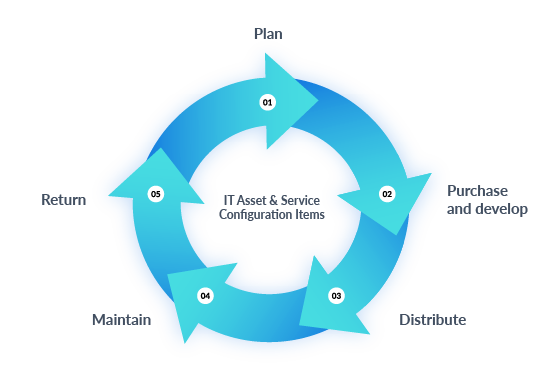
ROI for IT asset and service configuration management
Some of the economic benefits that contribute to positive ROI results found in utilizing IT asset and service configuration management include:
- Reduced IT costs – optimizing IT operations reduces costs in several areas, including infrastructure, outsourced services, and software management.
- Improving the quality of the service – ensure that existing services are always available and that new/improved services can be updated and released quickly.
- Risk mitigation – reduced downtime caused by system failures, cyber-attacks, security breaches, and change and configuration activities.
- IT staff productivity increases – optimizing IT staff activities through automation reduces the time spent “keeping the lights on” by the IT staff, freeing up valuable human resources.
There are plenty of ROI calculations that can apply to the business in areas such as:
- The number of tracked devices by an IT asset and service configuration management system.
- The effort and cost for a system/network engineer to manually handle IT asset and service configuration management.
- When (not if) a system failure occurs without a backup configuration.
- A mass configuration update for many systems or a new required deployment.
- When your company has to comply with an IT asset or service, request an audit, or pass a technical risk assessment.
Conclusion
The benefits of IT asset and service configuration management relate to all these applications. A comprehensive system with up-to-date information saves time, and time is money.
[1] Rich Gibbons, MD, ITAM Review. “ITAM INSIGHTS REPORT – Analysis of the changing cost of software, hardware and cloud by the industry charged with managing it.” Published in 2023.
[2] Gartner, Inc. “3 Steps to Improve IT Service View CMDB Data Quality.” Published in 2022.
[3] Forrester Research, Inc. “The State of Service Management, 2022.” Published in 2022.













Leave a comment