






















This article offers practical insights for anyone navigating organizational change – whether leading it or living through it. As a communications specialist in a global initiative spanning 90 countries, I saw firsthand how strategic communication can make or break transformation.
While this piece only scratches the surface, it highlights key lessons, tools, and strategies that helped drive meaningful change.
Project overview
Rolling out a global solution across time zones, cultures, and functions is no small feat. Over the past 16 months, I’ve learned that success depends not just on planning, but on people, trust, and adaptability. This article shares insights from my journey, with a focus on communication and change enablement.
Project in focus: Global roll-out of the new P&C system to 90 countries.
Why ADKAR?
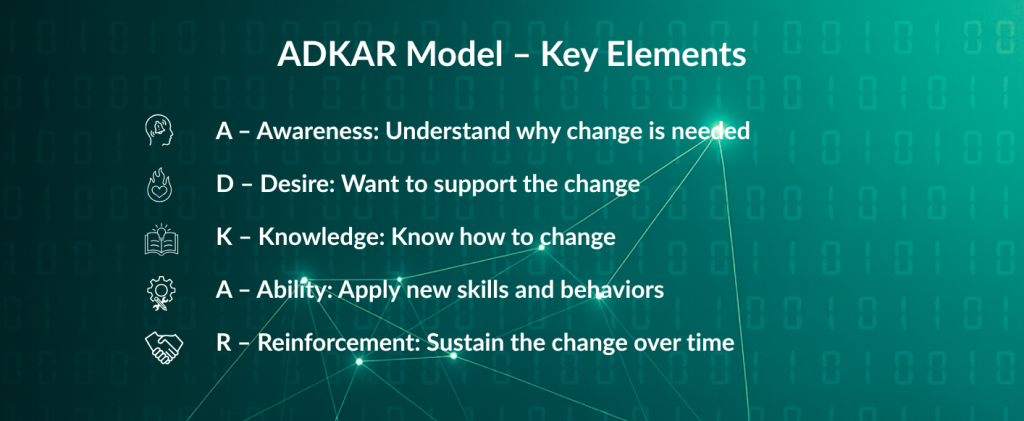
The ADKAR model by PROSCI is a go-to framework for managing change in large organizations. With over 25 years of research behind it, ADKAR is a practical, scalable, and people-focused approach – making it ideal for digital transformations, reorganizations, IT implementations, and process changes.
Why organizations choose ADKAR:
- Individual focus – Change happens one person at a time.
- Results-oriented – Emphasizes measurable outcomes.
- Structured – Each stage has clear goals and metrics.
- Flexible – Works across industries and change types.
- Practical – Enables tracking progress at every stage.
ADKAR = Awareness → Desire → Knowledge → Ability → Reinforcement
How we activated Communication for Change
If I had to point to one of the pillars of successful global change, it would be a strong change agent network. These local representatives understand their markets, have access to relevant channels, and know how to communicate effectively with their target audiences. You need them!
Engaging the change network early and consistently ensures:
- They’re first to know about upcoming communications.
- They help cascade messages, especially in crises.
- They provide input on formats and timing for local relevance.
Key considerations
- Local vs. Global Communication – Balance consistency with relevance.
Example: To factory line managers, we chose to communicate through local agents because, in the past, a global approach had proven unsuccessful, with key messages not being delivered, e.g., new processes not being reinforced. - Change Network Activation – Empower local representatives (reps) as communication champions.
Example: Thanks to a strong change network, messages were delivered to the right audience in a timely manner. - Direct vs. Cascaded Messaging – Choose based on urgency and audience.
Examples: Being mindful of how communication should be delivered was crucial for successful communication. - Timing & Content – Communicate the right message at the right time.
Example: Communicating too early resulted in reinforcing the new process prematurely, leading to IT incidents.
How we planned communication that worked
While communication may seem straightforward, it requires strategic thinking to be effective. The goal is simple: deliver the right message to the right people at the right time.
In practice, this meant asking:
- Should this be global or local?
- Should it be direct or cascaded?
- Is a live meeting needed or asynchronous materials?
- What format works best – text, visuals, video?
- Is the timing right?
- To what extent is the audience impacted?
These questions guided our communication planning throughout the project. Additionally, as a team, we had to establish our WOWs (ways of working) to ensure the timely delivery of our tasks. A defined communication workflow process helped us achieve that.

Formats that helped us reach the audience
Formats we used:
- Text emails
- Easy cards
- Slide decks
- Infographics
- Videos
Communication channels we leveraged:
- CRM
- Outlook
- Viva Engage
- MS Teams channels
- Recurring stakeholder meetings
Tools that supported us:
- The full scope of Microsoft 365 tools
- Salesforce Marketing Cloud
- Canva
- Synthesia AI
What we’d do again (and why)
- Engage change agents early – They know the audience and can help shape the message.
- Accuracy over speed – Better to be slightly late than wrong.
- Keep it simple – Clarity drives impact.
- Make every word count – Brevity matters.
- Correct message over design perfection – Prioritize the correct message over chasing design perfection.
- Celebrate milestones – Recognize progress to build momentum.
- Iterate and improve – Reflect after each wave and apply lessons.
- Center the employee experience – Ensure the right people get the right info at the right time.
How Change Models align across the lifecycle
While not all change management models follow the exact lifecycle – initiation → planning → implementation → reinforcement → evaluation – most share common principles.
The terminology and focus may differ, but the core idea remains: successful change requires deliberate preparation, effective execution, and sustained adoption.
- Kotter’s 8-Step Model –A leadership-driven approach emphasizing urgency, coalition-building, vision, empowerment, and cultural reinforcement. It focuses on strategic alignment and momentum but places less emphasis on individual emotional transitions.
- ADKAR Model (Prosci) – A people-centered model guiding individual change through five stages. Progress is assessed continuously through feedback and adoption, rather than a separate evaluation phase.
- Lewin’s Change Model –A simple three-step process: Unfreeze → Change → Refreeze. It’s clear and effective, but lacks detailed guidance for complex or evolving change scenarios.
- Bridges’ Transition Model –Focuses on the psychological journey: Ending → Neutral Zone → New Beginning. It emphasizes emotional readiness and internal adaptation over structured steps.
While various models offer valuable insights, at Sii, we distinguish ourselves by applying our own unique approach to change management in practice.

Summary
- Prepare, execute, and sustain – these are the shared fundamentals across most models.
- The terminology and emphasis vary depending on whether the model is process-oriented (like Kotter or Lewin) or people-oriented (like ADKAR or Bridges).
- Communication is the thread that connects strategy to execution – and people to purpose.

In the end, communication isn’t just about sending messages – it’s about building trust, enabling action, and sustaining change. If you’re planning a global rollout, start with your people, and the rest will follow.
Change Management essentials – Glossary of key terms
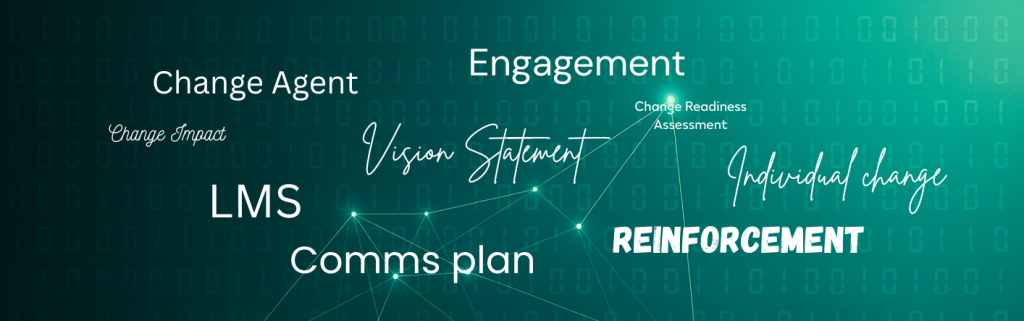
We live in a world where change is inevitable. Whether you’re leading change or may be impacted by transformation, this glossary serves as a practical reference for the core concepts that drive successful transformation. It’s designed for both professionals familiar with organizational change and individuals who may experience change in the future.
- Core Concepts
- Change Management – A structured approach to transitioning individuals, teams, and organizations to a desired future state.
- Change Lifecycle – The typical stages of change: Initiation → Planning → Implementation → Reinforcement → Evaluation.
- Change Implementation Plan – A roadmap outlining activities, timelines, resources, and responsibilities.
- Business Case – A formal justification for change, detailing expected benefits, costs, and risks.
- People & Roles
- Change Agent – An individual who drives and supports change (e.g., change lead, concierge, market representative).
- Personas/Stakeholders – Individuals or groups impacted by or influencing the change. Includes stakeholder identification and mapping.
- Sponsorship – Executive-level support that legitimizes and provides resources for the change effort.
- Readiness & impact
- Change Impact – The degree to which a change affects individuals, teams, processes, systems, or structures. It informs planning for communication, training, and support.
- Change Readiness – The preparedness of individuals and the organization to change.
- Change Impact Assessment – A structured evaluation of how change affects personas, processes, and systems.
- Resistance & Fatigue – Emotional or behavioral pushback due to fear, uncertainty, habit, or change overload. It can hinder adoption and requires proactive management.
- Communication & support
- Communication Plan – A strategy for informing and engaging stakeholders throughout the change journey.
- Training & Support – Activities that help employees adapt, such as training sessions, mentoring, and hypercare.
- Training Needs Analysis – The process of identifying skill and knowledge gaps that must be addressed for successful adoption.
- Sustainability & reinforcement
- Change Reinforcement – Tools and actions that sustain change within culture and processes (e.g., corrective actions, hypercare after go-live, continuous knowledge sharing).
- Sustainability of Change – The long-term integration of change into daily operations and organizational norms.
- Vision
- Vision Statement – A clear and compelling description of the desired future state that guides change efforts.
Summary
- Reinforcement: The Prosci ADKAR Model
- The four building blocks of change
- How to Make Change Initiatives Stick: Proven Reinforcement Strategies
- The determinants of organizational change management success: Literature review and case study
- Change Management Toolkit
- Change management interventions: Taking stock and moving forward
- Where Do Models for Change Management, Improvement and Implementation Meet? A Systematic Review of the Applications of Change Management Models in Healthcare











Leave a comment