


Ask a mature analytics team how their week actually went, and the answer is rarely about strategy.
Google Ads reports one conversion figure, GA4 shows another, and BigQuery holds raw event data that takes days to reconcile. A dashboard shows a number that looks wrong, so someone spends an afternoon tracing whether the fault is in a tag, the data layer, the warehouse, or the report. A stakeholder’s question waits three days for a SQL query. The consent banner needs to be rechecked before a privacy review.
For a CMO, Head of Analytics, or E-commerce Director, this is not just an operational nuisance – it creates fragmented data silos that obscure true full-funnel performance. None of this maintenance work is optional, and almost none of it moves the business forward
We call this maintenance mode: the state a data operation slips into once it is large enough to be valuable, yet complex enough to be fragile. The tooling is capable, the team is skilled, but a major share of that talent is spent policing setups that should simply work
We repeatedly saw this pattern while helping clients unlock the full potential of their digital setups. In every engagement, we hit the exact same bottlenecks and burned hours on repetitive tasks.
To move faster and smarter, we began building our own internal tools. This is the first article in a series about the system born from those real-world challenges – the Agentic Team Extension (ATE) –and understanding where it started explains exactly what it delivers.
Built in the trenches: Where ATE started
ATE was not designed as a product to sell; it started as internal tooling. Working on our clients’ digital architectures – analytics, tagging, warehousing, media, consent – our consultants kept hitting the same reconciliation and auditing work on every engagement.
So we began building small agents to take that load off our own delivery teams:
- to query a warehouse,
- to audit a tag container,
- to check consent behavior.
Over time, those agents became reliable enough that we ran them as a genuine extension of the team, hence the name. ATE is what that internal toolkit grew into, now deployed for clients rather than only for ourselves.
That history matters for one primary reason: ATE is a set of tools operated within a delivery model, not a self-service platform you switch on and hope for the best. The agents do the repetitive technical work; Sii consultants set up the conditions that make that work trustworthy.
Unifying the Google ecosystem: A coordinated specialist workforce
Instead of treating Google Analytics, Google Ads, BigQuery, Google Tag Manager, and Search Console as separate browser tabs that rarely agree – or struggling to reconcile them with external performance data from Meta (Facebook), LinkedIn Ads, and Salesforce – ATE unifies your entire marketing and CRM stack into a single, cohesive intelligence layer.
ATE is a multi-agent system. Instead of a single general-purpose bot that claims to do everything, it is a coordinated set of specialist agents, each an expert in one part of your data ecosystem, working under a single orchestrator.
It is built on Google’s Agent Development Kit (ADK) and Gemini Enterprise Agent Platform: a reasoning-focused orchestrator (Gemini Pro) coordinating fast, focused specialists (Gemini Flash) for GA4, BigQuery, Google Ads, Google Tag Manager, Search Console, and consent.
Pipeline
A request follows a consistent workflow rather than disappearing into a black box:
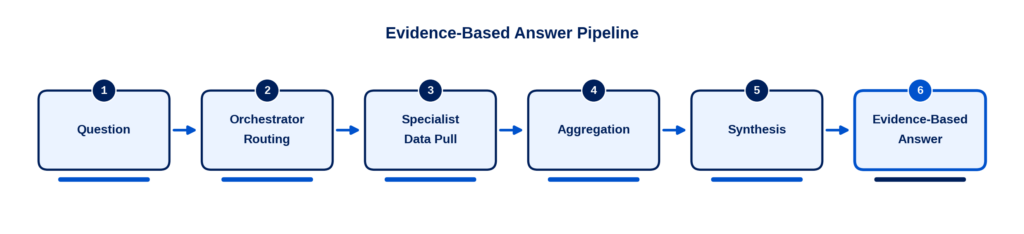
Two design choices make this dependable:
- Deterministic Aggregates: Aggregates are defined in a semantic layer so calculation logic is always the same – not improvised by a language model – ensuring arithmetic remains exact.
- Governed Metric Catalog: Specialist agents share a single metric catalog, so “conversion” or “session” carries the identical definition whether the question lands on the Ads agent or the GA4 agent.
A team of narrow experts working from one catalog behaves like an elite analytics team; a single general assistant asked to cover all of it tends to be shallow everywhere.
In practice: Full-funnel clarity in practice: Reconciling Google Ads, GA4, and GTM
A common e-commerce scenario demonstrates how these agents eliminate fragmentation.
An e-commerce retailer is testing a new Google Ads campaign against a redesigned landing page. A week in, the numbers disagree: Google Ads reports healthy conversions, but GA4 shows far fewer purchases from that campaign. Before leadership makes a budget allocation decision, the measurement itself has to be trusted.
Asked to explain the gap, the orchestrator puts three specialists on it simultaneously:
- The Google Ads Agent pulls the campaign’s clicks, spend, and conversions while checking its change history (were bids, budgets, or Final URLs changed?).
- The GA4 Agent pulls purchases for the same window by source/medium and walks the full funnel.
- The GTM Agent audits the purchase conversion tag on the new landing page and inspects the data layer it depends on.
The cross-check finds the root cause: the redesign renamed a data-layer variable, causing the GA4 purchase tag to send blank transaction values, while Google Ads, using its own conversion tracking, kept counting. GA4 was under-reporting; the campaign was performing successfully.
The commercial impact is significant: Without cross-agent reconciliation, an E-commerce Director might have mistakenly killed a highly profitable campaign due to flawed GA4 attribution. ATE surfaced the evidence in minutes, allowing a team member to fix the tag and re-run the campaign on clean data, protecting both ad spend and revenue growth.
Commercial impact: From data maintenance to revenue performance
Automating technical heavy lifting changes what people are responsible for. When reconciliation, auditing, and query-writing are handled by agents that do not tire, the executive question shifts from
Is this number right?”
to
The number is right – what do we do about it?”
The division of labor is the key benefit:
- The Agents take the operational load: repetitive queries, scheduled reporting, continuous tracking audits.
- Your Experts keep the strategic decisions: what to measure, which experiments to run, how to allocate capital, and whether a finding signals a market opportunity.
Response time on routine questions drops from days to the length of a conversation, while tracking audits that human teams could only run occasionally can now run continuously. Headcount stays flat, but team capacity moves directly from maintenance to performance growth.
Enterprise control: Modular, isolated, and governed
Handing technical work to AI agents is only acceptable if you remain in complete control, which is why governance is built directly into the architecture:
- Modular Architecture: Each agent is an independent building block. You deploy what your situation calls for – compliance first, warehouse access first, or media analysis first – and add capabilities as needs evolve.
- Single-Tenant Isolation: Every client runs its own isolated deployment, never a shared pool.
- Centralized Governance: A secure portal mediates access, credentials are held in Google Secret Manager, and every agent activity is logged with automated alerting over system behavior.
- Human-in-the-Loop: Agents read, query, audit, and report. They surface evidence and recommendations, but humans make the final decisions. As ATE evolves to execute automated actions, execution is designed around explicit human approval.
Pragmatic realism: Where to be careful
ATE removes toil; it does not replace judgment. An agent’s answer is only as good as the underlying data – poor data quality or an inconsistent tag setup will produce confident output that is still wrong, which is precisely why auditing agents exist.
Natural-language questions can be ambiguous, and high-stakes strategic decisions still require an experienced analyst’s oversight. The platform also operates within real-world infrastructure constraints, such as model quota limits and API rate bounds, which must be engineered around. Treating ATE as an instrumented assistant rather than an oracle is essential for obtaining reliable results.
The foundation: What needs to be in place
This is where the Sii delivery model provides value. The agents perform best when the foundational data layer is structured:
- A warehouse with modeled tables and agreed-upon metric definitions.
- A tag setup with a structured data layer.
- Defined consent states.
- Scoped access with properly managed secrets and system observability.
Most organizations do not have all of these prerequisites fully optimized on day one. Establishing these conditions – modeling the semantic layer, cleaning up tag containers, and defining governance – is the work Sii consultants perform. The agents provide leverage; the professional setup makes them trustworthy.
A strategic framework: The decision loop
To visualize how ATE operates across your stack, consider the loop every agent follows:
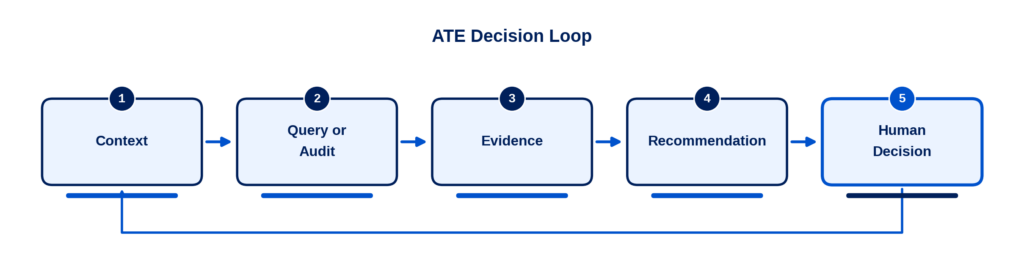
The agent gathers governed context, performs the operational heavy lifting, presents structured evidence, and proposes a course of action. The final decision remains with human leadership.

Sii x Google Cloud
As a certified Google partner, we modernize IT infrastructures and applications to create fully efficient and secure AI-enhanced digital workplaces.
Google cloud offeringWhere the series goes next
ATE represents a shift in how a data organization allocates human capacity – away from maintaining machinery and toward driving business performance.
The next article explores the first specialist agent in detail: The BigQuery Data Analyst Agent, which allows non-technical stakeholders to interrogate an enterprise data warehouse in plain language, eliminating multi-day SQL request queues.
If your team is ready to transition from fragmented data to full-funnel clarity, we are happy to talk about what an Agentic Team Extension would look like for your stack. Get in touch with Sii to start the conversation.
***
Next in the series: Talk with Your Data – The BigQuery Data Analyst Agent.













Leave a comment