




















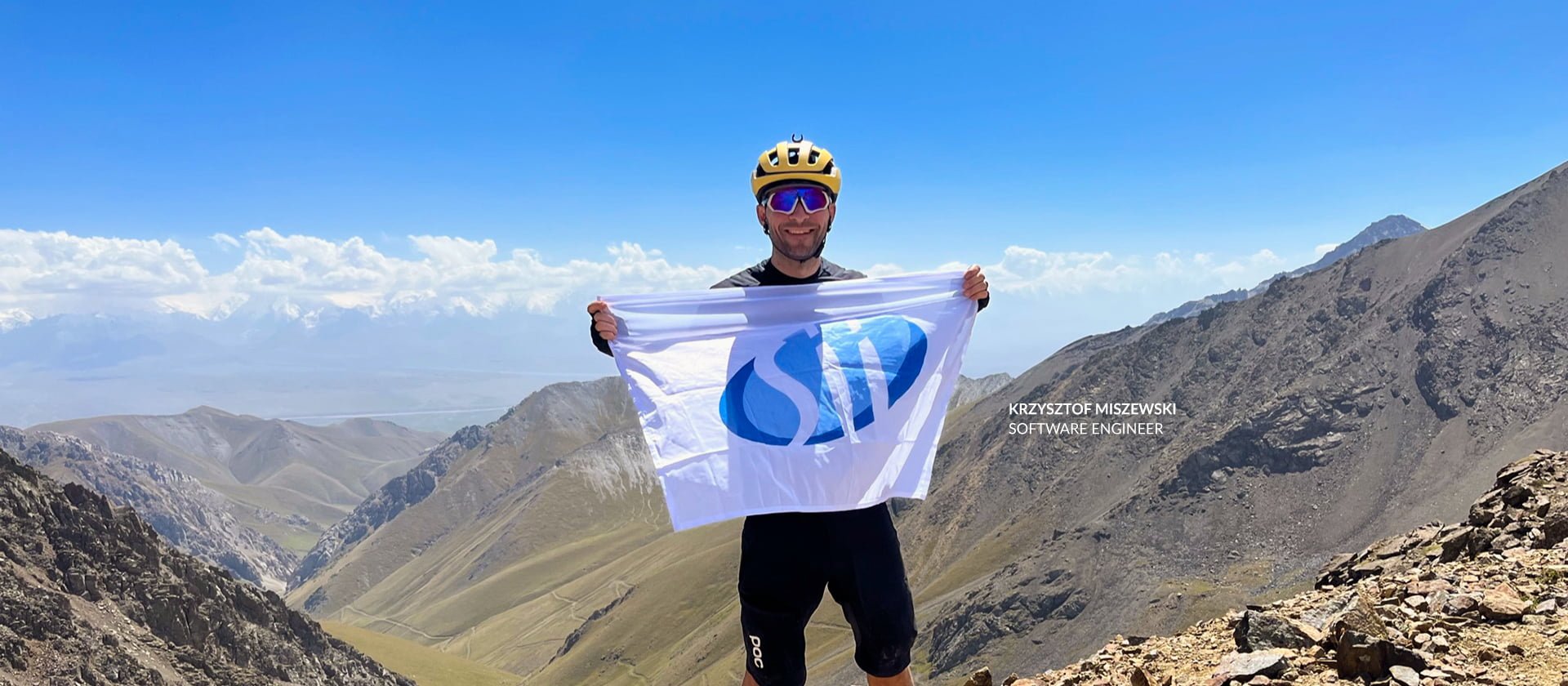
Check out the extraordinary journey of Krzysztof, who with the support of the Passion Sponsorship Program, took part in the Silk Road Mountain Race and covered 1 900 kilometers through the wilderness of Kyrgyzstan
Krzysztof Miszewski, Software Engineer and Scrum Master at Sii Gdańsk, works on the Wordline project during the day, and after hours he trains for triathlons and covers multi-mile routes on his bike. This year Krzysiek decided to take part in the Silk Road Mountain Race in distant Kyrgyzstan, as he received funding in this year’s edition of the Passion Sponsorship Program. Relying entirely on himself and his skills, in 12 days he covered nearly 1 900 kilometers through the mountains and wilderness of the historic Silk Road in Kyrgyzstan.
Where did you get the idea to participate in such a demanding race? What do such adventures give you?
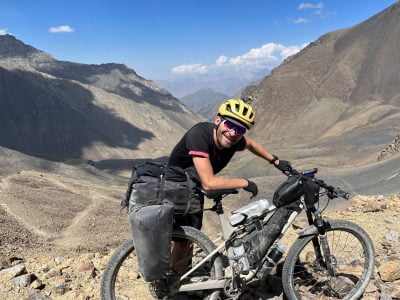 I’ve already done a few different races in my life, at first, I began with shorter and less demanding ones. Through these events I met people with the same passion and many of them mentioned the Silk Road Mountain Race. This route was believed to be one of the toughest of its kind, so it was only a matter of time until I decided to tackle it myself! 😊 I was also encouraged by the opportunity to visit a distant country and the chance to experience the culture of Kyrgyzstan.
Such races allow me to completely disconnect from the surrounding reality. Thanks to them I gain distance from many things. My only concern is where to set up a tent or where to prepare food. I don’t think about work, money, shopping, loans, or even social media. This is a good time for me to reevaluate my life, look at it from a different perspective and appreciate what I have. On the finish line of the Silk Road Race, I was not expecting any medal or fanfare, it was more important that I was able to complete it.
What exactly is the Silk Road Mountain Race?
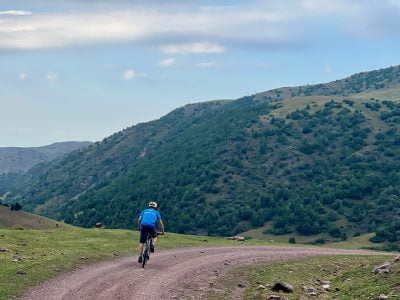 This is one of the most famous ultra-races in the unsupported bikepacking form, where participants rely only on themselves and the occasional commercially available services. The race takes place along the former Silk Road, covering around 1 900 kilometers over six passes with an altitude of 4 000 m. This route is difficult for a couple of reasons: high altitudes, long roads without any civilization, and temperature differences: -15 °C on the peaks and 40 °C in the valleys. I had to be prepared for all weather conditions, including snow, wind and downpours. All this made packing even more difficult. I had to think of everything that could help me survive in such harsh conditions, proper clothing, food and accommodation.
The difficulty of the race is demonstrated by the number of people who manage to complete it: last year, out of 110 starters, only half reached the finish line in time.
I imagine that you have to train well in advance before such a challenge.
On this type of expedition, you cover about 160 kilometers a day with considerable altitudes, so you need to start going on similar multi-day expeditions much earlier. Then, it is also recommended to test the equipment you’ll use at the target event. Before the trip itself, you need to check literally everything: whether a comfortable saddle is actually comfortable after a few days of riding, whether our shorts don’t chafe us, or whether we need more diverse food on the route.
I’ve been cycling for about 7 years now, but I don’t limit myself to just bike training, I also run and swim, as I’m also preparing for triathlons. This year, after the triathlon season, I focused exclusively on mountain biking: getting on the bike every day and doing long climbs every weekend.
How does such a race look like from the technical point of view?
You can compete solo or in a pair, I chose to go alone. Of course, for some time you can ride together with random participants you meet, but you can’t team up with each other.
As for equipment, everyone has a different strategy, good preparation is one of the elements of this race. I took a tent with me, but I also slept in a few commercial places available along the route. I needed a moment to breathe, to shower, and to recharge my equipment.
Such a race means spending hours alone in the wilderness. How do you cope with this, what thoughts come to mind then?
Unfortunately, thoughts can often be difficult, especially after a few days, when fatigue sets in and there are harsher weather conditions. The most common thought is: “why am I here and why do I do this?”. In such moments, the most important thing is to remember why you decided to race and to be aware that the conditions will surely improve and this temporary slump will pass. I know that soon I will be able to enjoy freedom, beautiful views and adventure again.
Besides, the beauty of these expeditions is one of the main reasons to keep pedaling, to conquer the next peak, to plan food and lodging for the next day or section… And so it goes, kilometer after kilometer, hour after hour, until we finally reach the finish line. Sometimes during the ride, I also like to listen to music, podcasts, or audiobooks, they distract me from all the bad thoughts.
What was the most difficult part of the race that you had to face daily?
The organizer is famous for arranging the route in such a complicated way that participants will remember it well – both in terms of the beauty of the surrounding nature, as well as the everyday struggle with the weather and elements of the route. Each day had something difficult or unique about it, and all the fun was about overcoming those difficulties. It certainly wasn’t easy to get up at the crack of dawn, and get on the bike with a sore butt that was refusing the contact with the saddle again 😉 But as the hours and miles passed, the body adjusted to the riding mode and stopped rebelling.
And did you have moments of real doubt that made you want to go back?
 There were no such moments, but I had two big crises. The first happened right on the first day, when we were after a very difficult climb to the highest peak of the entire route (4 165m). At about 3 500m above sea level, I had to push the bike over big and loose rocks, which took me about six hours. I was rather unprepared for this on the first day. The descent later wasn’t any easier, as the route was not passable and involved a lot of bike pushing, this time downhill. Once we finally managed to ride, I made a silly mistake (probably already due to fatigue – we took off at midnight and it was already approx. 15–16-hour ride). I suddenly pressed the front brake and flew over the handlebars. I took a bit of a tumble, damaged my bike and felt I had enough for the first day. At that time, I did not look forward to the next one. However, that day was exceptionally challenging compared to the rest of the route. On the second day, it looked completely different, so I got up with new strength and I kept riding!
I had my second crisis in the second half of the route. The highlight of the day was the ascent of Tosor Pass, about 3800m above sea level. The organizer warned us against this section, pointing out the very strong winds blowing in this area. I was mentally prepared and focused on this ascent, but it went surprisingly smoothly, contrary to its warning description. The wind was blowing, but it was bearable. By the time I was at the top, I was in a great mindset, and began to revise my plans for the day: it seemed to me that I would get through a lot more than I had originally anticipated. My joy was premature, however, because all the fun with the weather only started on the descent. With every meter, the wind was intensifying, blowing straight in my face. At first, I hoped that as the altitude dropped the wind would calm down, but it was just the opposite. On the descent, I had a speed of about 10km/h with active pedaling – without it, the bike barely rode down even though there was a steep gradient. The battle with the wind eventually lasted about 7 hours, I felt completely exhausted and resigned. Despite the beautiful views, I didn’t manage to enjoy them – I kept waiting for the wind to stop. This was my mistake, I lacked patience that day and I couldn’t accept the conditions as they were, which is very important during this race and something I should already know. In the end, on that day, I drove a lot less than I had originally planned. I went to bed and this was probably the first moment when I started counting down the days and kilometers to the end.
After 12 days you completed the race. What were your feelings at the finish line?
At first, there was a great joy and relief! And a moment later slight disbelief and something like sadness that this adventure has just ended. But the worst thing happens after a few hours and days when a rested person is already beginning to miss this simple life and finds it difficult to get back to civilization and “normal” life.
Congratulations, it really sounds like an amazing adventure! Is your work at Sii connected to your passion in any way?
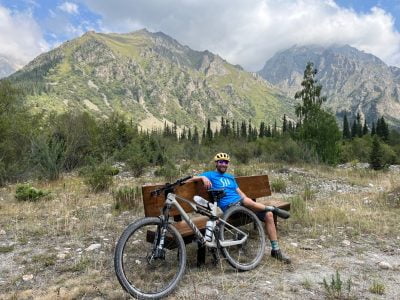 Thanks to my passion for sports, I have learned to manage my time well – every day I have to combine training with work and family responsibilities, and I can’t waste time on unnecessary things, like unproductive meetings or tasks. I try to eliminate such elements from my own and my team’s work.
Cycling has also helped me to change my mindset about projects to be completed: I don’t think of a project as a scary whole, but as a bike route. 😊 I try to break the two into smaller parts: projects into individual tasks, and races into sections to be ridden. This way I know my plan of action and that step by step I will achieve my goal. In addition, I have learned that in the mountains the weather is unpredictable and one moment we can be caught in a storm, only to see the sun right afterwards. The knowledge that there is always sun after rain has allowed me to stop worrying about temporary crises at work.
You took part in the race thanks to the co-funding from the Passion Sponsorship Program. What do you think of this collaboration?
I’m glad that thanks to the Program I’m able to share my passion with other Sii employees. In addition, the financial support from the Program was extremely helpful: both the participation fee and the preparations, including the purchase of appropriate equipment required a lot of money, so I am very grateful that I had the opportunity to receive support from Sii and the Passion Sponsorship Program.
If you also want to pursue your sports dreams with the support of the Passion Sponsorship Program, apply and join our team!


