






















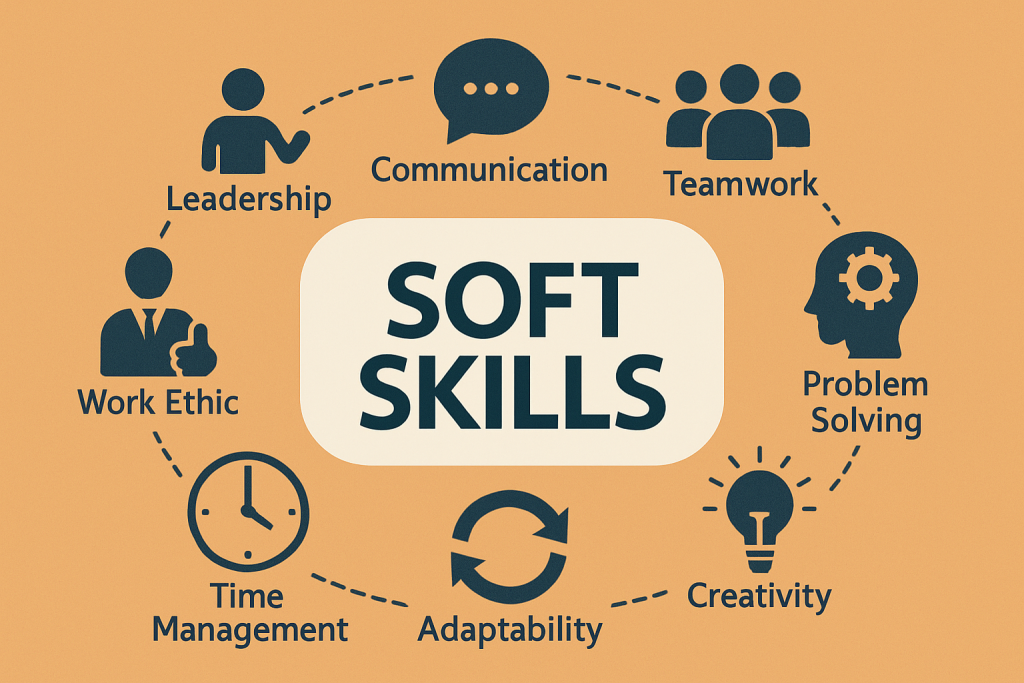
Soft skills help us function better in daily life and at work, and allow us to communicate effectively with others. These skills include empathy, problem-solving, teamwork, and creativity. They help us do well in both professional and social settings.
Soft skills have become increasingly important in recent years, as they often determine career success, even in an increasingly automated job market. The development of technology, especially artificial intelligence (AI), is bringing significant changes to the job market. Tasks once done by humans are now increasingly being taken over by machines and algorithms.
This raises the question: Can AI replace all human skills?

Hard vs. soft skills: what can AI do, and what is still human?
To answer whether AI can replace all human skills, we first must define hard and soft skills and understand where humans have the advantage and where AI excels.
AI competencies
AI is ahead in the area of hard skills. These specific, measurable abilities can be learned through study, training, or practice, such as programming, data analysis, foreign language knowledge, and document management.
What can AI do in this area?
- Code – tools like GitHub Copilot, ChatGPT, and CodeWhisperer can generate code in multiple programming languages.
- Translate languages – AI is improving at translations (DeepL, Google Translate) and understanding context.
- Analyze data – AI algorithms can spot patterns, predict trends, and automate reports.
- Manage routine tasks – chatbots, email automation, and AI-powered CRMs (like Salesforce Einstein) are now standard.
AI dominates here because these skills rely on logic, rules, and data algorithms.
Human competencies
So, where does the human advantage lie? In soft skills, which are interpersonal abilities related to communication, emotions, relationships, and attitudes, things like empathy, creativity, teamwork, and emotional intelligence are included. These skills are hard to measure, and since they require an understanding of context and emotions, AI struggles to master them.
Here’s why humans still hold the lead and what AI can’t do (and likely never will):
- Feel emotions – AI can analyze emotional data (like tone of voice or facial expressions), but doesn’t feel or understand emotions like humans do.
- Create truly original ideas – AI generates text, images, and music based on patterns but doesn’t “create” in a human sense.
- Have authentic conversations – even advanced chatbots still lack an understanding of long-term context in conversations.
- Adapt to social and cultural changes – humans better understand the complexity of social contexts.
The importance of soft skills
While AI is revolutionizing many aspects of work, soft skills are an advantage for humans over machines, and empathy, among other things, remains crucial in roles such as leader and advisor.
Teams combining human competence and artificial intelligence’s power can achieve more innovative results. The rapid development of AI requires employees to be flexible and ready to learn new tools. Adaptability allows for better use of technology and adaptation to new professional realities. Teamwork requires the ability to communicate and effectively manage diverse talents, especially in the context of human collaboration with AI.
In a world dominated by AI, leaders must be able to manage not only people but also technology. Strong leadership skills help to effectively implement innovations, motivate teams, and make strategic decisions in an era of digital change. Thus, in the face of the growing role of artificial intelligence, soft skills remain critical to professional and organizational success, enabling better collaboration with technology and effective management of the changing work environment.
The role of soft skills in future jobs
As technology, demographics, and society change rapidly, soft skills are becoming key to professional success in the years ahead. Reports from organizations like the World Economic Forum (WEF) and LinkedIn highlight the growing importance of interpersonal, adaptive, and cognitive skills in future work.
According to the World Economic Forum’s 2023 report, skills like analytical thinking, resilience, flexibility, creativity, leadership, and social influence are considered key for the coming years. Employers increasingly value employees’ ability to adapt to a changing work environment shaped by technologies like AI and data analysis. Deloitte Access Economics predicts that by 2030, 66% of jobs will rely on soft skills such as emotional management, communication, and creativity.
As technology advances, many jobs will require not just technical skills but also strong soft skills. Examples include:
- Customer service specialists require empathy, active listening, and problem-solving abilities.
- Project managers need communication skills, team management, and adaptability.
- Healthcare workers must show empathy, patience, and the ability to work under pressure.
- IT specialists – besides technical knowledge, they are increasingly expected to work well in teams and communicate effectively.
A LinkedIn report points out that skills like communication and leadership remain important even in the age of growing AI. Employers seek employees who can combine technical expertise with interpersonal skills.
An EY report emphasizes that social skills like empathy, creativity, and teamwork will be more important than hard skills. Employers are increasingly focusing on candidates’ ability to adapt and learn throughout their careers.
Education and development: How to prepare for new job market demands
The rise of AI is not just changing job roles; it’s also redefining what it means to be “prepared” for the future. It’s no longer just about knowing digital tools; it’s about how we collaborate with both people and technology. Soft skills, like adaptability, empathy, and communication, are becoming essential.
So, what can we do to keep up?
- Learn quickly and flexibly for life – continuous learning is key in the face of rapid technological change. It’s not just about getting a specific degree but being able to absorb new knowledge quickly in various contexts. Online courses, micro-certifications, and soft skills training are fundamental to modern professional education.
- Practice soft skills – many employees develop technical skills in a structured way, like learning programming or data analysis. Soft skills should be treated the same way – training in empathy, teamwork, and mental resilience should be ongoing through tools like 360° feedback, coaching, or cross-department projects.
- Build emotional resilience and change management skills – AI brings uncertainty: Jobs and organizational structures are changing. One of the key abilities in the coming decade will be managing ambiguity and stress from continuous transformation. Investing in workshops on emotional intelligence, mindfulness, or internal mentoring is smart.
- Learn to collaborate with AI, not compete with it – a crucial mental shift is moving from competition with technology to collaboration with it. Workers need to learn how to use AI as a partner that supports their daily tasks. This requires openness, experimentation, and a responsible approach to new tools.
- Foster a learning culture in organizations – not only individuals but also companies need to change their approach. Companies that invest in developing their employees’ soft skills gain a competitive edge. Creating spaces to share knowledge, test new ideas, and learn from mistakes is becoming a “must-have” for organizational culture.

Conclusion
In the age of artificial intelligence, soft skills are becoming more important because they are essential for professional success. While AI has dominated hard skills (programming, data analysis, and translation), interpersonal skills (empathy, creativity, teamwork) remain human strengths. AI, despite its advanced capabilities, cannot understand emotions, create innovative ideas, or have authentic conversations, which are still human advantages.
As AI continues to grow, soft skills become the foundation for successful collaboration with technology. Emotional management, flexibility, and adaptability are the keys to success in a rapidly changing work environment. In the coming years, employees who combine technical and interpersonal skills will be better able to thrive in an automated world.
Investing in the development of soft skills is not just a response to technological change but a crucial element in gaining a competitive edge. In the face of digital transformations, skills like communication, leadership, and creativity provide an irreplaceable value that AI cannot replace. Therefore, it’s essential to invest in these skills to navigate the future of work, where technology coexists with human expertise.
Sources
- Workplace Learning Report 2023: Building the Agile Future | LinkedIn
- Człowiek vs. AI. Czy maszyny odbiorą nam pracę? – Gospodarka – Forbes.pl
- 10 zawodów, które może zastąpić AI
- The Future of Jobs Report 2023 | World Economic Forum
- Jakie kompetencje będą cenione w przyszłości przez pracodawców? | EY – Polska





Leave a comment