
























The AI gold rush is crashing into cold, hard economics. After burning through budgets on ChatGPT-like services that deliver generic fluff instead of business-critical insights, companies are finally asking the right question: why settle for a Swiss Army knife when you need a scalpel? Enter vertical AI – purpose-built models that actually know your domain. The problem? Building one can cost more than your entire tech stack.
But what if I told you there’s a backdoor to custom AI that costs pennies on the dollar? This post explains how to build a model that thinks like your business without major investments.
Parameter Efficient Finetuning
The secret weapon hiding in plain sight is parameter-efficient fine-tuning – a technique that laughs in the face of traditional training costs. Instead of retraining every single weight in a massive model (imagine renovating an entire skyscraper when you only need to redecorate the tool storage), methods like LoRA (Low-Rank Adaptation, described here) surgically insert tiny, trainable modules into frozen pre-trained models.
Think of it as genetic modification for AI. LoRA adds specialized “skill implants” that teach the model your domain expertise while leaving its core intelligence untouched. The result? You get 90% of the performance benefits of a fully custom model while training only 0.1% of the parameters. It’s like having a PhD-level assistant with years of experience in your company who learns your business in hours, not months, and costs about as much as your monthly coffee budget.
The following sections are technical. If you’re uncomfortable with math or advanced AI concepts, feel free to skip to the results section, where we answer the question: Does LoRA really work?
A deep dive into LoRA
LoRA operates on a deceptively elegant mathematical principle: most neural network weight updates during fine-tuning exist in a low-rank subspace. Instead of updating the full weight matrix directly, LoRA decomposes the weight update into two smaller matrices that, when multiplied together, approximate the full update. This decomposition dramatically reduces the number of trainable parameters – from potentially millions down to thousands – while maintaining most of the adaptation capability.
The architecture keeps the original pre-trained weights completely frozen while injecting trainable low-rank matrices in parallel. During forward passes, the model simultaneously computes outputs using the frozen original weights and the new low-rank adaptation, combining their contributions. The rank hyperparameter controls this trade-off between efficiency and expressiveness, typically set between 1 and 64 for most applications.
Lower ranks slash memory and compute requirements but may limit the model’s ability to capture complex domain-specific patterns.

LoRA’s initialization strategy prevents disruption of pre-trained knowledge. One adaptation matrix starts with small random values while its counterpart begins at zero, ensuring the adaptation initially contributes nothing to the model’s behavior. This preserves the pre-trained model’s capabilities while allowing gradual, controlled adaptation. A scaling factor further modulates adaptation strength, preventing catastrophic forgetting of valuable pre-trained knowledge.
The technique’s efficiency gains are substantial:
- optimizer states are only maintained for the tiny fraction of trainable parameters,
- gradient computation flows only through the low-rank path,
- memory usage scales with rank rather than full parameter count.
This enables fine-tuning on consumer hardware that would otherwise require enterprise-grade infrastructure, democratizing custom model development across organizations of all sizes.
Does it really work?
We recognize that theoretical promises don’t guarantee real-world performance. While LoRA presents compelling advantages on paper – reduced training costs, faster adaptation, and lower computational requirements – these benefits must be validated in practice.
Enterprise deployments demand concrete evidence that parameter-efficient approaches can deliver production-grade results without sacrificing model quality. Our validation process addresses whether LoRA can maintain accuracy when adapting to specialized domains while delivering the promised cost savings.
We selected clinical document summarization as our evaluation domain, specifically, transforming complex medical documentation into accessible patient-friendly summaries. This use case exemplifies vertical AI applications within healthcare while addressing a critical need for improved patient communication and health literacy.
The task demands both domain-specific medical knowledge and sophisticated natural language processing capabilities, making it an ideal testbed for parameter-efficient fine-tuning approaches.
The setup for experimentation
Our experimental framework compared LoRA-adapted models against a baseline general-purpose solution across multiple architectures, focusing on quantifying performance improvements in domain-specific tasks while measuring computational efficiency gains. Text summarization quality can be evaluated across several dimensions using a range of metrics.
- Factuality is measured with LongDocFACTScore, which compares each sentence in a summary to the most similar sections of the source document using sentence embeddings and cosine similarity. This approach helps determine how accurately the summary reflects the original content.
- Relevance is commonly assessed with metrics like ROUGE and BERTScore. ROUGE evaluates the overlap of words and phrases between generated and reference summaries, including n-gram matches (ROUGE-N), longest common subsequences (ROUGE-L), and sentence-level splits (ROUGE-Lsum). BERTScore, on the other hand, compares contextual embeddings from a BERT model to capture semantic similarity, accounting for paraphrasing and meaning beyond exact word matches.
- Readability is measured using formulas such as the Dale–Chall and Flesch–Kincaid scores. The Dale-Chall formula considers sentence length and the proportion of difficult words, while the Flesch-Kincaid score rates text ease on a 0–100 scale, with higher scores indicating easier readability. Together, these metrics provide a well-rounded evaluation of summary quality.
Tools
For training and evaluation, we utilized a comprehensive biomedical dataset, the eLife corpus (~330MB uncompressed). That dataset provides substantial volumes of peer-reviewed scientific literature spanning diverse medical and biological domains, offering the complexity and domain specificity necessary to test LoRA’s adaptation capabilities in specialized healthcare contexts rigorously.
To train our models efficiently, we used UnSloth as a fine-tuning library. Unsloth provided optimized LoRA implementations that allowed fine-tuning with high throughput and minimal latency. The model training was conducted using T4 and L4 GPUs, which offered an excellent balance of computational power and efficiency for large-scale fine-tuning tasks.
To serve the model locally on a personal machine, we leveraged LM Studio, which provided a lightweight and flexible environment for running inference smoothly.
As a baseline, we considered GPT-4.1, which asked for summarization using a simple prompt from the paper WisPerMed at BioLaySumm: Adapting Autoregressive Large Language Models for Lay Summarization of Scientific Articles.
You will be provided with the abstract of a scientific article. Your task is to write a lay summary that accurately conveys the key findings and significance of the research in non-technical language understandable to a general audience.
Abstract of the scientific article:
[Abstract]
Lay summary for this article:
The results
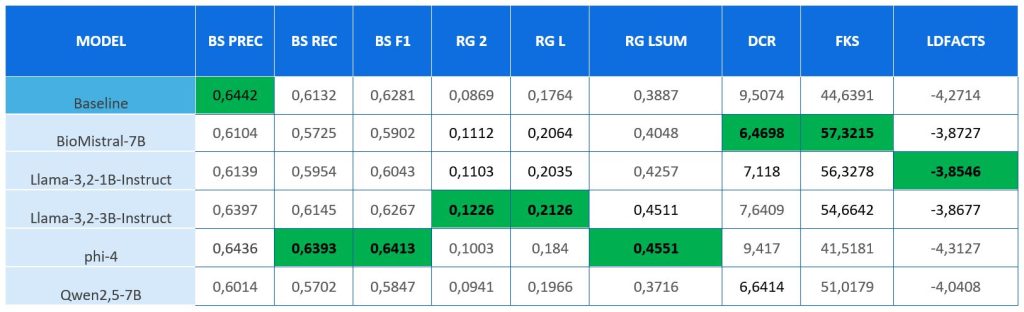
The experimental results validate LoRA’s theoretical advantages with compelling empirical evidence. LoRA-adapted models consistently outperformed their general-purpose counterparts across nearly all evaluation metrics, with GPT-4.1 managing only a narrow victory in a single category.
This performance gap becomes even more remarkable when considering both the economic implications and the dramatic size differential: achieving these results required training costs measured in dozens of dollars rather than thousands, while the resulting specialized models – weighing in at just 7B, 3B, or 1B parameters – consistently outperformed GPT-4.1’s estimated 1.76 trillion parameters.

The summary
The combination of superior domain performance, minimal training investment, over 100 times smaller models, and deployment flexibility demonstrates that parameter-efficient fine-tuning can deliver enterprise-grade specialization without enterprise-scale infrastructure requirements.
For organizations seeking to implement domain-specific AI capabilities, this approach offers a compelling alternative to the resource-intensive pursuit of ever-larger general-purpose models. It enables sophisticated AI applications within realistic budget and infrastructure constraints.













Leave a comment