


Organizations today are implementing more change than ever before. Digital transformations, AI deployments, shifts in operating models, and mounting pressure on productivity mean that the ability to lead change effectively is becoming one of the most important sources of competitive advantage.
According to Gartner, the average employee experienced 10 planned organizational changes in 2022, compared with just two in 2016 – a fivefold increase in organizational change over only six years (Gartner report, 2023), while engagement, wellbeing, and trust in leaders are all coming under growing pressure.
It’s no surprise that employees are experiencing change fatigue. From senior leadership down to operational teams, organizations are seeing rising exhaustion driven by constant transformation. It’s therefore hard to expect that new initiatives will be met with the same level of energy and engagement as they were just a few years ago.
As might be expected, the pace of change is not going to slow down. Quite the opposite. Geopolitical, social, technological, and economic shifts are affecting organizations simultaneously, creating a domino effect in which one transformation triggers the need for others. The rise of AI is just one example. In many companies, changes to skills, processes, technology, and culture are happening in parallel, and each one affects how people work.
In this environment, many organizations are grappling with the same challenge: strategic decisions don’t translate quickly enough into employees’ everyday behavior. In practice, this is rarely just a matter of strategy quality or communication from leadership. Increasingly, the deciding factor turns out to be the effectiveness of middle managers, who act as the bridge between an organization’s ambitions and its operational reality.
Prosci research shows that 58% of employees prefer to receive change information directly from their direct manager, rather than through a leadership email or a company newsletter. It’s the manager that employees turn to with questions like:
What does this mean for me?
Why now?
Should I be worried?
And it’s the manager, not the CEO, not the transformation sponsor, who is able to answer these questions in a way people actually trust.
As a result, the manager can become either transformation’s greatest accelerator or its greatest brake. The key question, then, is not whether to involve managers in change, but how to create the conditions that allow them to lead it effectively.
Why the manager’s role is gaining importance
Although managers rarely openly question the direction of change, they often approach it with more caution than leadership teams assume in their plans. For many of them, each new initiative brings not only new opportunities but also additional workload, responsibility, and risk of failure.
Managers today sit at the center of nearly every transformation initiative. They are accountable for business results, implement new processes, translate strategic decisions into concrete actions, and support their teams in coping with uncertainty. As a result, they become the group most heavily burdened by the effects of organizational change.
In practice, managers’ challenges tend to center on four areas.
Growing workload
Every new transformation expands the scope of managers’ responsibilities. New duties appear faster than organizations remove old ones. As a result, frontline leaders are forced to pursue operational targets and lead new change initiatives at the same time.
AI transformation makes this dynamic especially visible. While senior leaders focus on new business opportunities and employees benefit from productivity gains, managers take on responsibility for overseeing the quality of AI-generated output, building new team capabilities, and managing operational risk. At the same time, performance expectations remain unchanged, or even increase.
Limited organizational capacity
The most important change-related activities, like building engagement, addressing concerns, and having conversations with the team, take time. Yet time is precisely one of the most limited resources managers have today.
Role ambiguity
In the AI era, the manager’s role is evolving from coordinator of work toward architect of an environment where people and technology collaborate. Coaching, skill development, decision-making under uncertainty, and creating the conditions for learning are all becoming increasingly important. Yet many organizations still haven’t clearly defined what they now expect from their leaders.
Lack of adequate support
When taking part in a transformation means greater responsibility without additional resources, caution becomes the natural response. This isn’t reluctance to change; it’s a risk calculation and a limited capacity to absorb yet another initiative.
Three mistakes that limit transformation effectiveness
Looking across change initiatives in organizations, three recurring mistakes stand out.
Leaders are brought in too late
Managers often learn about a change only once they’re expected to communicate it to their team. This limits their ability to build credibility, answer questions, and shape a convincing narrative around the transformation.
Organizations don’t prepare them for the new role
According to Prosci research, 63% of respondents believe managers don’t receive the preparation, tools, and support they need to lead their teams through change. At the same time, this same group is widely recognized as critical to transformation success.
They’re treated as recipients of change, not co-authors of it
The most effective transformations involve managers as early as the solution-design stage. This makes use of the knowledge of the people who best understand the operational consequences of strategic decisions and who can identify potential implementation barriers early on.
This last mistake takes on added significance in the context of AI. There’s a temptation today to use digital transformation as an opportunity to “flatten” the structure and cut the management layer; after all, AI can summarize, coordinate, and partially replace administrative work.
Yet a Cognizant and Pearson report, based on a survey of 750 HR leaders across the US, UK, and India, tells a very different story: 95% of respondents consider middle managers essential to employees making effective use of AI, and 92% see them as essential to redefining job roles as everyday work changes. That’s hard to square with the idea that the manager’s role is becoming less important.
How to prepare middle managers to become Change Ambassadors
Fortunately, the manager’s role in change can be deliberately designed. The Prosci methodology describes five roles a manager plays in the change process, known by the acronym CLARC:
- Communicator,
- Liaison,
- Advocate,
- Resistance Manager,
- Coach.
These roles can then be translated into four practical stages for preparing leaders to guide their teams through change.
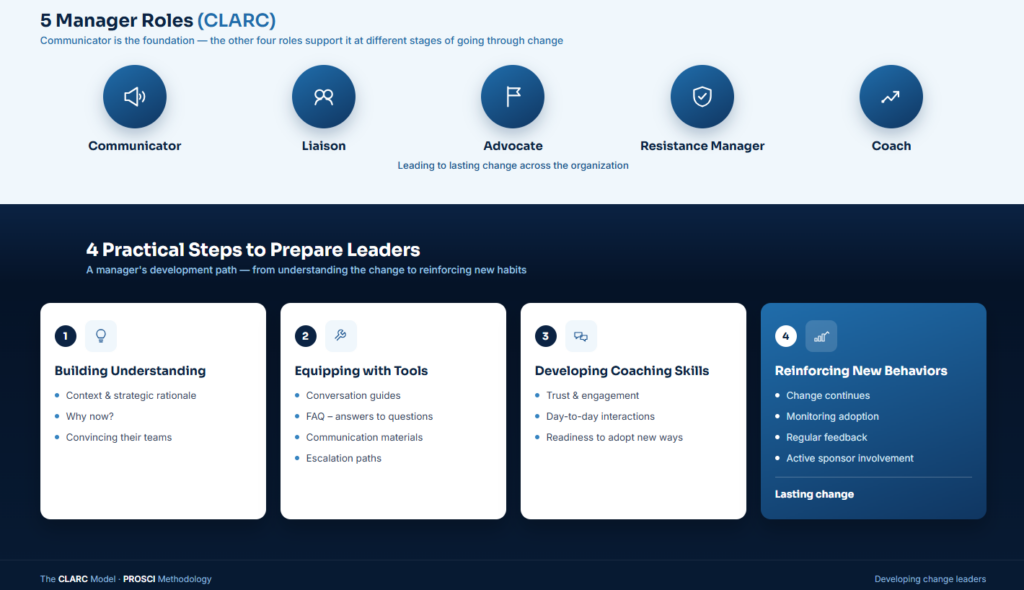
Building understanding
Managers must first understand the strategic rationale for a change themselves before they can communicate it convincingly to their teams. It’s not enough to simply inform leaders of the direction of change. They need to be given the context to answer the fundamental question: why are we doing this now?
Equipping them with tools
Effective organizations give leaders practical support: conversation guides, answers to frequently asked questions, communication materials, and clear escalation paths for issues.
Developing coaching skills
The most important conversations about change don’t happen at company-wide meetings; they happen in the manager’s day-to-day interactions with their team. That’s where trust, engagement, and readiness to adopt new ways of working are actually built.
Reinforcing new behaviors
Change doesn’t end once a solution is implemented. Making new ways of working stick requires ongoing monitoring of adoption, regular feedback, and active involvement from transformation sponsors. Leaders need to not only communicate the change, but also consistently reinforce the behaviors that are meant to last within the organization.

Business Process Outsourcing
We advance business performance with specialized services – from HR, data management, operations to consulting and digital marketing.
BPO offeringThe leader’s new mandate
Discussions about transformation usually focus most on strategy, technology, and new operating models. But ultimately, change is a human experience. It’s people who have to learn new ways of working, let go of old habits, and find their footing in a new organizational reality.
That’s exactly why the manager’s role matters so much today. Not because managers formally own the change, but because they are closest to the people who actually have to implement it. It’s from their vantage point that you can see fastest whether a transformation is taking hold in everyday work or remaining just an ambitious plan on paper.
At a time when organizations are facing an ever-growing number of parallel transformations, it may turn out that their most valuable resource isn’t the ability to design more change – it’s the ability to help people move through it. And that is an area where the manager’s role remains hard to replace.













Leave a comment