



























In a world where most services are just two clicks away on a smartphone screen, digital onboarding is gradually becoming an industry standard rather than a service that allows a bank to stand out from its competition.
Customer onboarding is usually one of the first significant interactions a client has with a given institution, and as such, it has a huge impact on shaping their experience. It’s the link between acquiring a customer and building their long-term relationship with the bank. As in life, you only get one chance to make a good first impression!
Financial Services Cloud (hereinafter FSC) offers tools that enable banks to prepare a fast, intuitive, and fully digital experience, exactly what customers currently expect from their banking service providers.
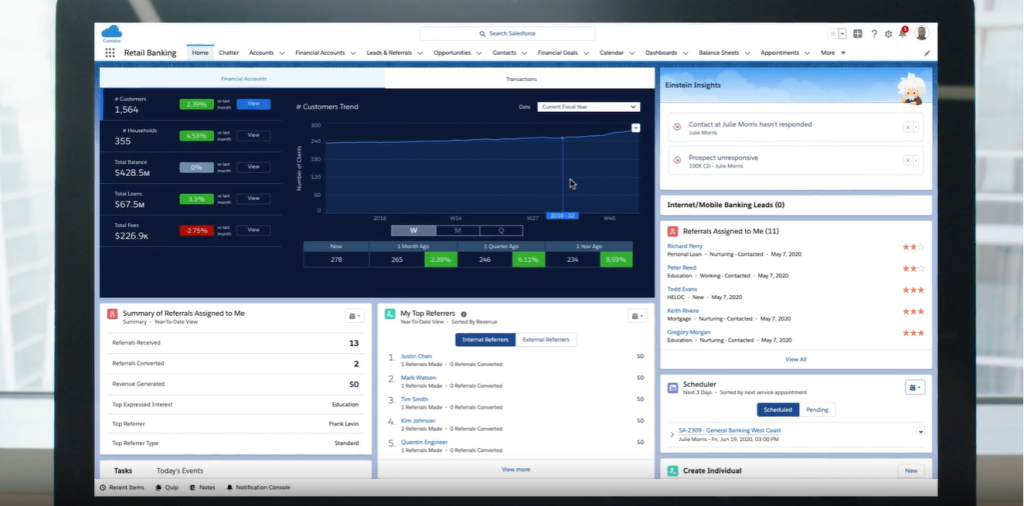
Customer onboarding – what is it?
Onboarding in banking is the process of introducing new customers to banking services, including registration, identity verification, and opening a bank account. A key element of the process is compliance with legal regulations such as KYC (Know Your Customer) and AML (Anti-Money Laundering), which ensure security and eliminate the risk of abuse against the bank.
Who benefits from implementing digital onboarding in a bank?
The simplest answer to this question is that everyone benefits – the bank’s customers, employees, and consequently, the bank itself.
Customer:
- Thanks to the digitization of onboarding, the customer benefits from a simple and fast process that does not require their physical presence in a branch, saving time and reducing effort.
- Onboarding is available to the customer 24/7. The customer decides when and where to use the bank’s services.
- The implementation process is more efficient, mostly self-service, and does not require contact with the customer service center.
Bank:
- Increased automation and digitization of the customer onboarding solution frees up employee time. Optimizing employee working time allows for redirection to other more beneficial tasks from the bank’s perspective.
- Reduced labor intensity of the process, which is associated with lower customer onboarding costs.
- Better data quality thanks to automation and less manual work.
- Ability to offer services to customers 24/7.
- Ability to accurately measure the time consumption of the onboarding process.
- Satisfaction of customers using the latest digital solutions, promoting their pro-ecological attitudes (saving paper).
- The bank’s image follows the latest trends and meets the needs of its customers.
How does the Financial Services Cloud support the onboarding process?
FSC is a solution dedicated to financial institutions built on the Salesforce platform. It extends Sales Cloud and Service Cloud with functionalities that support managing relationships with customers of banks, insurance companies, and wealth management firms.
The FSC application offers a ready-made, pre-configured solution called Integrated Onboarding for digital customer onboarding, on the basis of which a company can prepare its own solution tailored to its needs.
Let’s see how FSC supports its clients in accomplishing this task.
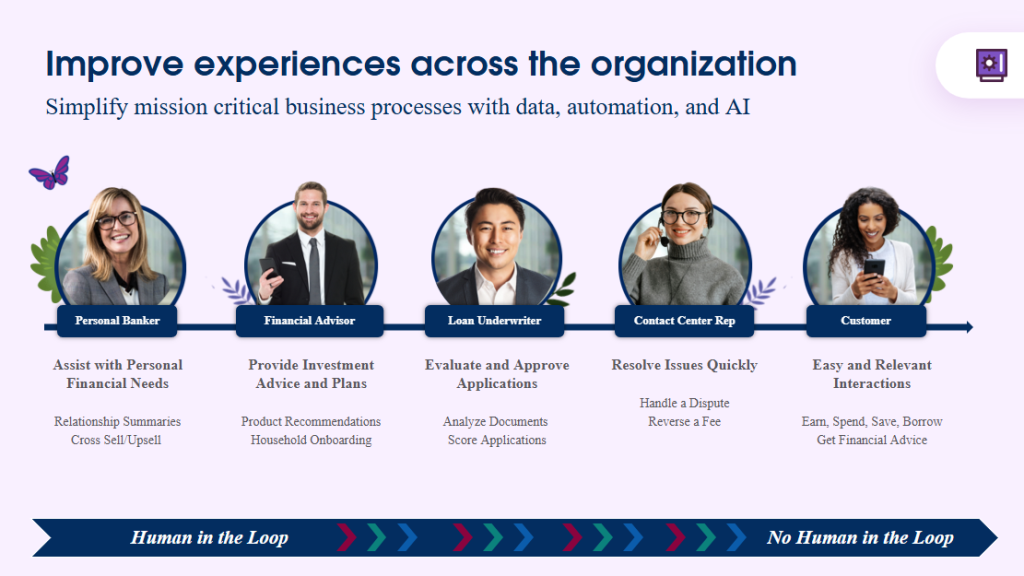
4 stages of the onboarding process
Automation guides the bank’s customers through 4 stages of the onboarding process:
- The customer’s acceptance of the application based on the data, documents, statements, and consents provided by them.
- Verification of the application – ensuring that the application is complete, has all the necessary documents, and that the customer has given all the required consents in the process.
- Verification of regulatory requirements – verification and acceptance of the application from the customer, also possible thanks to integration with external systems.
- Creation of a customer account – initiating the process of creating an account for a new customer through bank procedures.
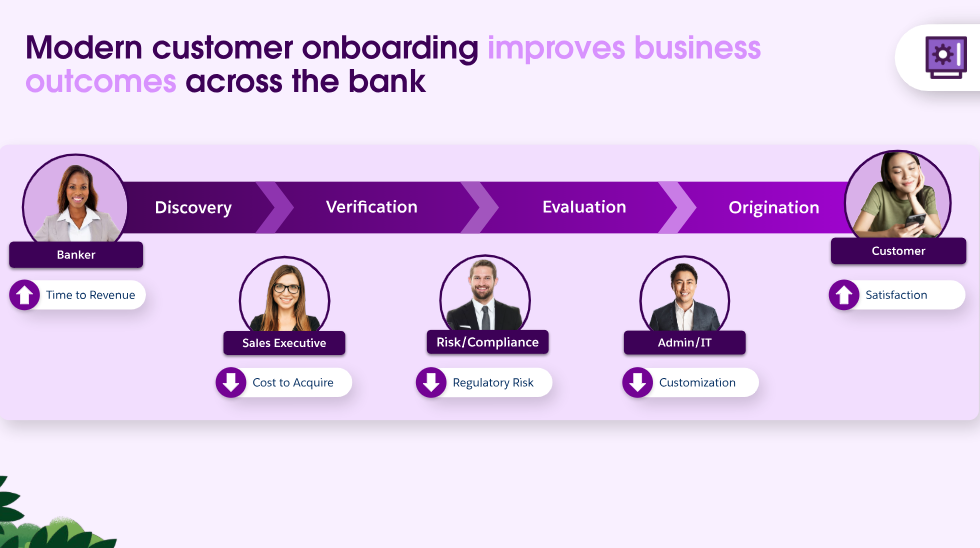
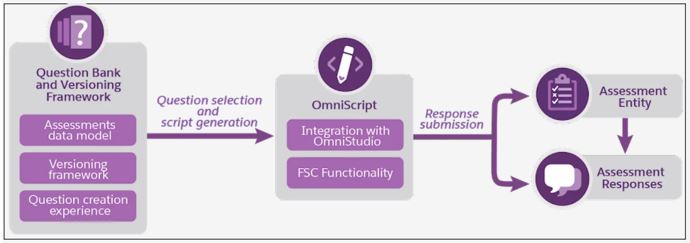
Accepting the application from the customer is supported by the Discovery Framework functionality
Data from the customer is collected during the onboarding process using the Discovery Framework. This is a native FSC functionality that is widely used because it allows for:
- Creating a repository of questions along with their versioning (the repository creates a so-called single source of truth), which allows for efficient management of updating the content of questions and their versions.
- Creating forms based on selected questions or sets of questions (e.g., questions about personal data, so-called question packages).
- Tracking answers provided by customers through various contact channels – which guarantees a view of the versions of questions presented to customers and answers for the purposes of a potential audit.
- Integration with external providers to analyze and verify the client.
- Ongoing monitoring, reporting, and auditing of information provided by customers.
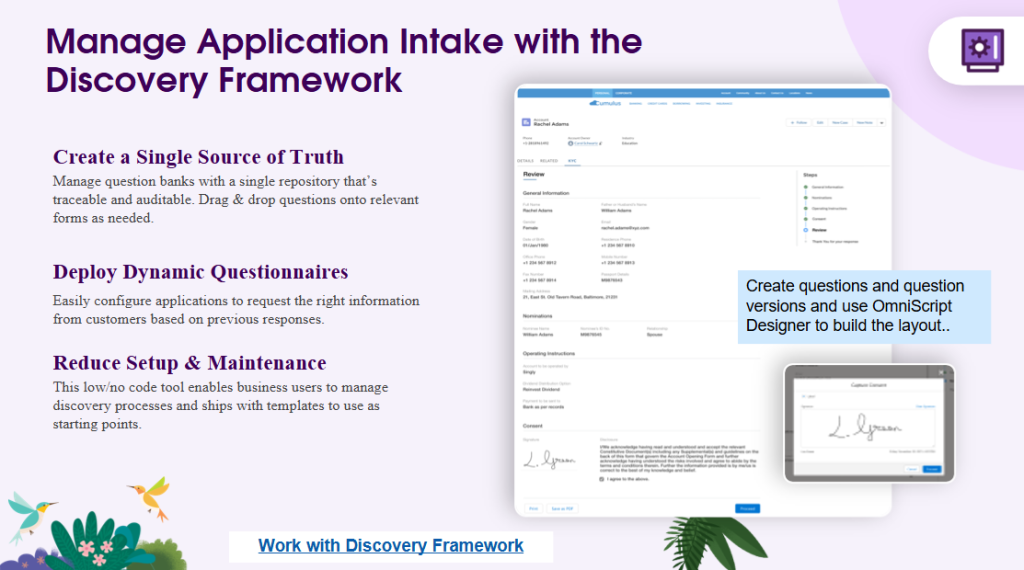
Importance for the system administrator
Thanks to the Discovery Framework, the system administrator can define the process in Salesforce in a few steps:
- Creating questions in the repository (or filling the repository with a ready-made set of questions from another source),
- Using the FSC’s ability to build a form containing the target set of questions,
- Making the finished form available on the customer portal.
The functionality’s data model will enable the storage of customer answers along with information about the version of the question to which the answer was given.
How to further enhance the onboarding process?
When starting the onboarding process, the customer expects it to be quick and intuitive. Any difficulties at this stage may encourage them to abandon further proceedings, so it is worth ensuring that the process is user-friendly and shortens the interaction time with the bank as much as possible.
FSC offers additional functionalities to be used when designing the onboarding process, which can be helpful for this:
- Auto-completion of data for the customer – in the case of data that the bank has about the customer or is publicly available about them. Using this mechanism shortens the time to complete the form and affects the user’s positive experience.
- The ability to return to a previously completed form allows the customer to interrupt the application process and return to it conveniently.
- A component that allows you to submit a signature – using a signature with a finger or mouse (obtaining consent; this is not a certified signature).
- QR code component – redirects the customer from the portal through which they submit their application, e.g., to a partner’s website or to perform a specific activity, such as taking a photo of a document and sending it to the application.
It is worth emphasizing that FSC has very extensive possibilities in creating and making available to end users dynamic, refined forms[1] with high functional and aesthetic qualities, which additionally affects the customer’s level of satisfaction with the service provided to them.
It is important to note that thanks to the high degree of available personalization of appearance, you can create any-looking form and fit into the bank’s existing branding. This is key to providing the user with a visually consistent experience regardless of the contact channel or the matter they want to handle.
Use superpowers!
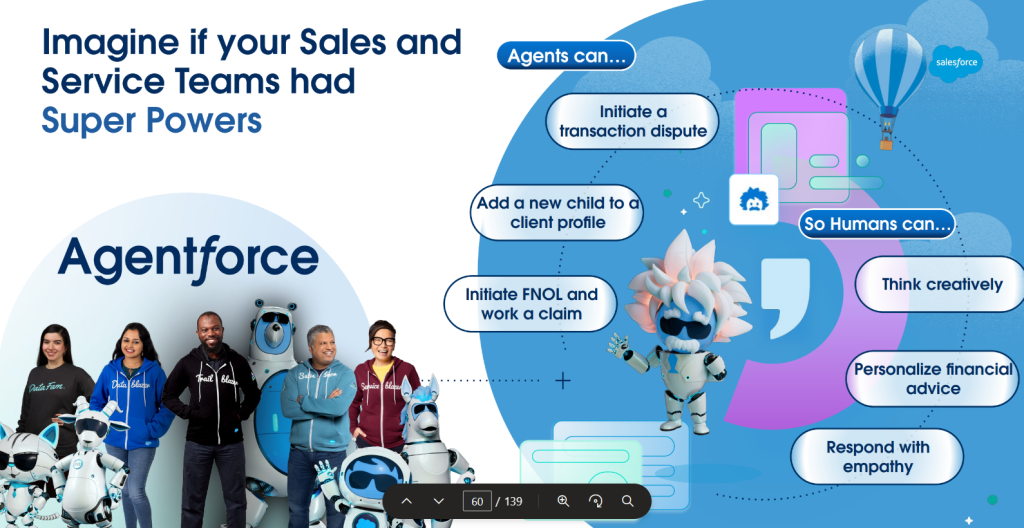
Generative agents are changing the modern landscape of services, including banking services. Agentforce, a Salesforce generative agent, can also support bank employees and customers in onboarding.
Agentforce can guide the customer through the process of applying for a new bank account based on existing procedures and perform actions in the background that are part of the process. If customer interaction with a bank employee is necessary, Agentforce can smoothly transfer the case it is handling to them, summarizing it and suggesting further steps. Agentforce will also support the employee responsible for accepting the KYC procedure or another participant in the process by automating tasks and eliminating the number of repetitive actions to be performed.
How does it all work?
The functionality through which customers can prepare a digital onboarding process is based on the Integrated Onboarding framework, which is composed of tools and functionalities offered as part of FSC and other native capabilities of the Salesforce platform.
OmniStudio Process Automation powers overall process automation and guides the customer, and then the bank employee, through the following steps:
- The customer completes the data via a portal prepared using Experience Cloud[2] in a form based on OmniScript. The form guides them step by step through the account application process (an element of the Discovery Framework discussed above).
- The data is pulled into the Salesforce system. If there is a need to integrate with other data from external sources, the system uses the data transformation tool, Integration Procedure[3], to obtain it. The updated data is presented to the bank employee in the system using FlexCards[4], a component with great flexibility in terms of data visualization.
- Automation modifies the status of the customer, who is no longer the lead, and updates them for the customer during onboarding.
- The system initiates an internal verification process by a bank employee authorized to do so. The verification is based on data provided by the customer, obtained from external systems – and can be supported by the use of a native decision engine, Business Rule Engine[5], giving the possibility of using advanced logic, e.g., to assess the risk for a given customer. Like the customer application, the verification process is based on a form prepared in OmniScript.
- After positive customer verification, this stage of the process is completed. Thanks to automation, a new stage is launched – the system automatically creates a request for another department, which is responsible for initiating the creation of an account for the customer.

Get to know your customers through the KYC model
FSC standardly includes a data model that allows the bank to carry out the mandatory KYC procedure efficiently. The model allows you to create a current customer profile and store information about their personal data, legal information, and other data used to confirm identity, control, and verify the customer (also as a result of integration with external providers).
Not only B2C, but also B2B
FSC is a solution aimed at the broadly understood financial sector – wealth management companies, commercial banks offering services for individual clients, corporate clients, the insurance sector, and lending companies. The tools and solutions offered within its framework will be suitable for supporting both individual client service and B2B clients.
This also applies to the onboarding solution, which will find wide applications, both in terms of the sector and the type and profile of the end customer. However, for institutional or corporate clients, it may certainly require greater adaptation to the specific business need, which is associated with the high degree of complexity of the needs of the institution serving this type of client and the non-standard nature of the processes.

Summary
Customer onboarding provides an excellent opportunity to create a lasting first impression. An effective onboarding process increases customer satisfaction, strengthens loyalty, and lays the foundations for long-term relationships. In today’s world, technology and digital transformation are shaping how banks establish individual customer relationships from the beginning.
Financial Services Cloud is an innovative platform that provides modern solutions to streamline the onboarding process for customers in the banking sector and improve their experiences with financial institutions.
***
If you are interested in Salesforce topics, take a conical look at other articles by our experts as well.
***
[1] We are referring to the OmniScript solution. This tool allows for the creation of interactive forms, guiding users step-by-step through successive screens to complete specific tasks (data entry, consumption of information provided to the user). OmniScript is part of OmniStudio, a suite of tools that extends process automation capabilities within the platform. OmniStudio is offered as part of the FSC license (as well as with other industry solutions from Salesforce’s offerings).
[2] A Salesforce tool that enables the creation of portals for end-users (B2B or B2C customers), partner portals, and self-service customer sites.
[3] A solution used to integrate data from Salesforce and external sources, it is part of OmniStudio.
[4] Custom user interface components that are placed on a page to display data from Salesforce or external sources, offering extensive customization options for appearance and functionality. Part of OmniStudio.
[5] Native Decision Engine – A set of tools that provide the ability to apply advanced logic and automate complex decision-making processes. Part of OmniStudio.











Leave a comment