


The fast-moving world of marketing automation never stands still, and Salesforce’s current actions clearly show this. We’re witnessing a big shift in marketing technology strategy, where the company has strategically moved to building the next generation of Marketing Cloud directly on its main platform.
In my opinion, this isn’t just another product update or add-on; it’s a fundamental re-architecture aiming to create a single, data-driven, and AI-powered future for marketing across the entire Salesforce ecosystem.
The result of these efforts is the long-awaited platform, unofficially known as Marketing Cloud on Core. This is a true milestone for Salesforce, as it’s their first “native child” in marketing automation, built from scratch. The new solution comes in two editions: Marketing Cloud Growth and Marketing Cloud Advanced. Their introduction opens up new perspectives and creates big opportunities for customers, partners, and the entire market, starting a new era in marketing automation.
In this article, we’ll take a closer look at:
- why Salesforce committed to a native platform,
- what fundamentals underpin the strength of Marketing Cloud on Core,
- what specific features it offers, and, just as important,
- what people in our community are thinking about this change.
Historical perspective – from acquisitions to core
For years, Salesforce expanded its marketing portfolio through strategic acquisitions. These included ExactTarget (now Marketing Cloud Engagement, geared towards B2C needs) and Pardot (now Marketing Cloud Account Engagement, designed for the B2B market). Even though these tools are very powerful, they function as separate applications, requiring connectors for data exchange with the main Salesforce CRM platform.
This paradigm shift towards a native architecture in new products seems to have the potential to solve previous integration challenges. It allows seamless and organic integration with the rest of the Salesforce Customer 360 platform. This approach promises a more unified, potentially more efficient, and certainly more controlled product development.
This move allows Salesforce to leverage years of experience and user feedback from the acquired platforms. They had plenty of time to look at and use the best solutions from Marketing Cloud Engagement, such as advanced segmentation, real-time personalization, and multi-channel customer journeys. The same goes for Marketing Cloud Account Engagement, taking its features for lead generation and qualification, integration with sales, and funnel analytics.
As a result, Marketing Cloud on Core has the potential to become a “best of breed” solution, combining proven elements from older platforms while eliminating their weaknesses and potential difficulties. This approach reminds me of an experienced chef who uses the best cooking methods and ingredients from different types of cooking to create their best dish.
It’s worth noting that, right now, Marketing Cloud on Core (in Growth and Advanced editions) is dedicated to the small and medium-sized business (SMB) segment, for both B2B and B2C. However, observing the dynamic product development and carefully analyzing Salesforce’s statements, I’m convinced that its scope and functionalities will be expanded, eventually covering the needs of large enterprises.
What’s more, while Salesforce officially states that Marketing Cloud on Core is not intended to replace Marketing Cloud Engagement or Marketing Cloud Account Engagement and that these platforms will continue to be developed, for me, the clear sign is that the main development effort will be focused on the “Core” platform.
Foundations: Core Platform + AI + Data
Now that we understand why Salesforce made this move, let’s examine this new platform’s intended purpose and the key capabilities it offers future users.
The overall concept of Marketing Cloud on Core is based on three fundamental pillars that form the product’s vision and technological foundation:
| One trusted platform | AI that saves time | Personalization across the customer journey |
| At the heart of the new product is the idea of a single, reliable platform. This allows all departments, from marketing and sales to customer service and online shopping, to get a common, clear view of the customer within Salesforce Customer 360. It also makes it easier to create automated, multi-step customer journeys. | A key differentiator of this platform is the extensive use of Artificial Intelligence. Solutions provide support in daily operational work. Generative AI supports content creation (like campaigns and emails), and predictive AI can optimize processes (like the best time to send messages). | The platform aims to enable the creation of deeply personalized interactions. This is possible by intelligent data unification provided by Data Cloud. As a result, every interaction becomes more relevant and tailored to individual needs. |
These main ideas are the backbone of Marketing Cloud on Core. The platform turns them into practical, useful tools and features that fully support marketers in three key areas, which I would classify as.
Quick campaign creation with AI
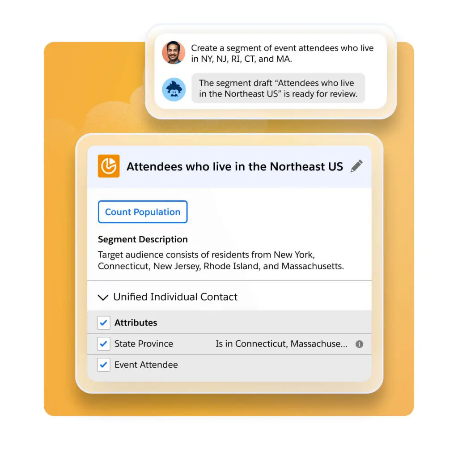
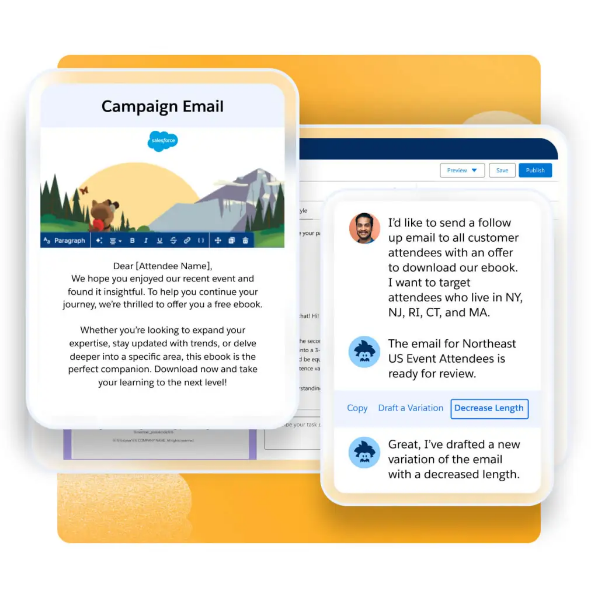
- Campaign support via Agentforce – thanks to Generative AI and Data Cloud, quick brief creation, automatic segmentation, email/landing page drafting, and customer journey building.

- Segmentation – creating audience segments based on natural language analysis and data unified from various sources in the Data Cloud.
- Email creation – generating initial versions of email content with personalization based on customer data from across the organization.
Managing customer relationships and experiences
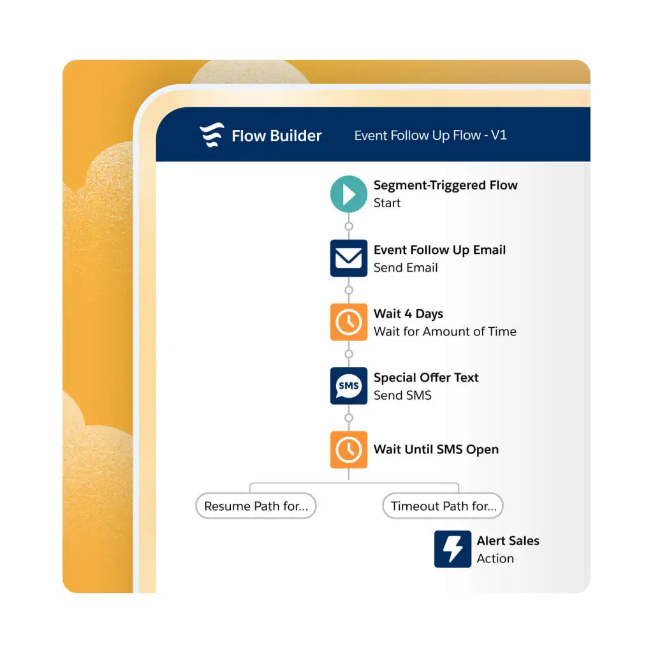
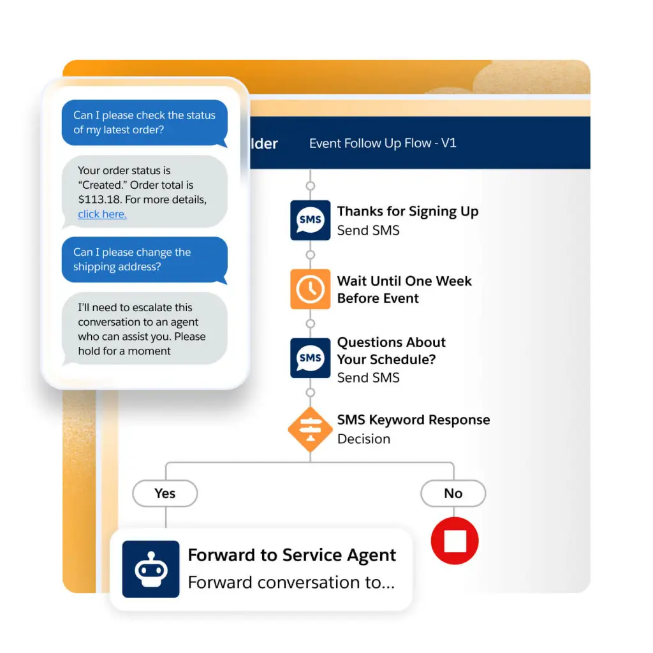
- Multi-channel communication – automate customer journeys across email, SMS, WhatsApp, and trigger sends based on Data Cloud information using the Flow tool.
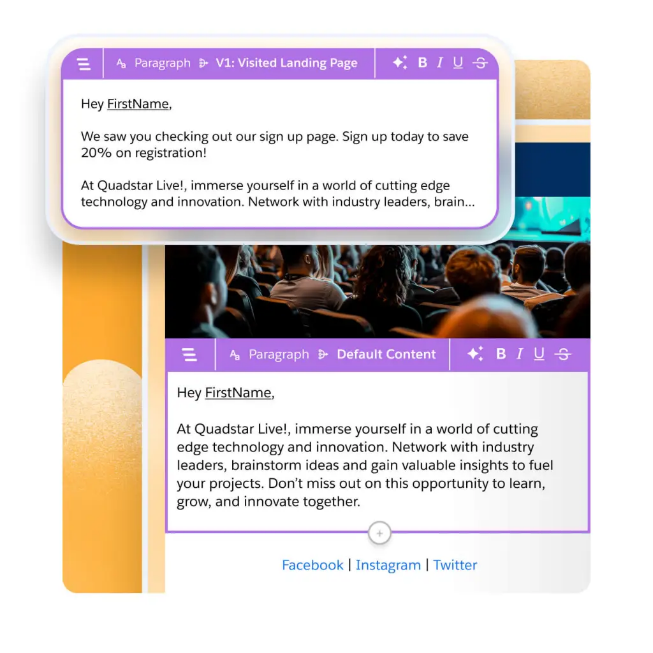
- Advanced personalization – personalizing marketing content by utilizing customer attributes and based on data from various interactions.
- Two-way SMS conversations – conducting interactive SMS conversations linked to data and team processes. Support for self-service transactions via AI Agentforce.
Analyzing and optimizing marketing results
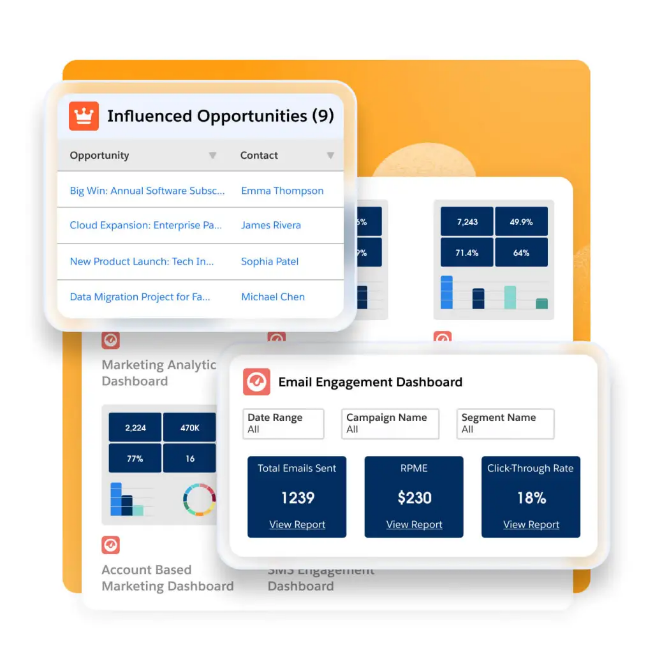
- Campaign performance analysis – measuring campaign impact on closed-won opportunities and ROI. Analysis of interactions (forms, landing pages, email, SMS) and key email metrics.
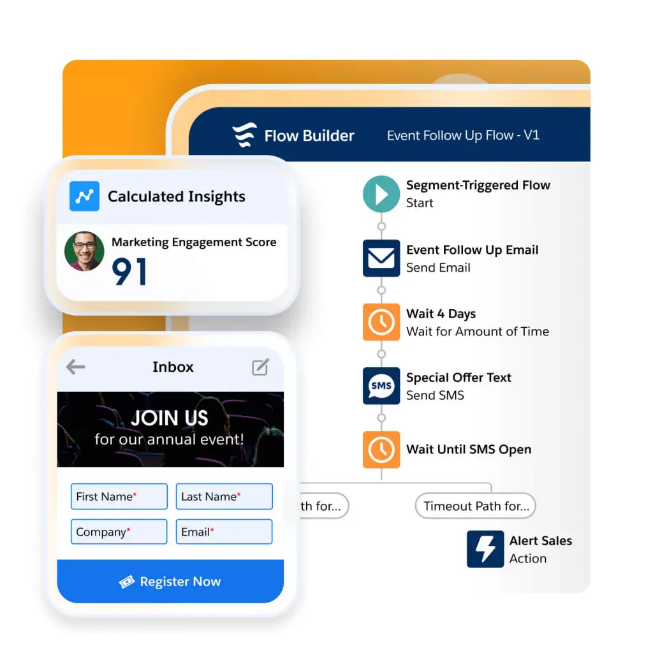
- Lead nurturing and scoring – collecting and scoring leads based on ready-made and custom models and AI-powered predictive engagement scoring to identify the most valuable leads.
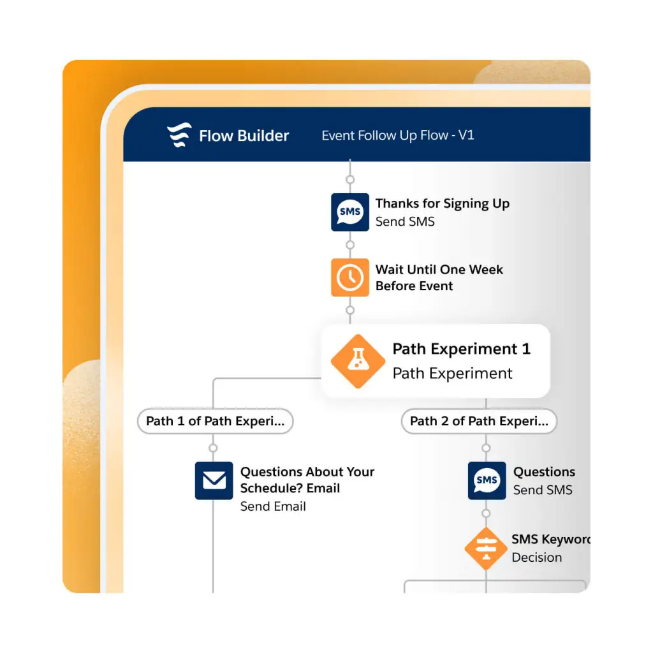
- Path experimentation – conducting A/B tests in customer journeys and campaigns, testing variants of channels, messages, and personalization.
In light of the presented capabilities, it becomes clear that Marketing Cloud Core is a powerful tool designed for the modern marketer. The integration of the platform’s key functionalities has the potential to increase the effectiveness of marketing activities significantly. This will enable users to create more engaging campaigns, build deeper customer relationships, and make more informed data-driven decisions, potentially translating into measurable success in the dynamic marketing world.
Industry sentiment
The transition to a native platform naturally causes diverse reactions within the Salesforce community, including implementation partners and Marketing Cloud specialists. As a consultant in this environment every day, I observe a mix of cautious optimism, curiosity, and a certain degree of uncertainty.
On one hand, people accept that the change is inevitable. The future of the platform undoubtedly lies in Core and Data Cloud. Many, including myself, see the big potential in having a single system and the possibilities of combining AI and unified data. This gives us hope for solutions that are easier to manage and more consistent. On the other hand, I also feel a clear sense of concern, especially among consultants and developers whose specialized skills, such as knowledge of AMPscript and SQL, have been crucial for working with tools like Marketing Cloud Engagement. The future of these specific skills on the new, more declarative platform seems uncertain, which is a natural source of worry.
My perspective
For now, we should maintain a healthy skepticism and be mindful of concerns regarding the new platform’s maturity and adoption pace. We must remember that Marketing Cloud Core has not yet achieved full feature parity or the flexibility offered by older solutions, for example, in code personalization using AMPscript or SSJS.
This brings up important questions I ask myself:
- Will the new platform effectively replace existing systems in a predictable timeframe?
- Will it lead to the loss of valuable functionalities available on older platforms?
Due to these current imperfections and limitations, specialized skills in advanced functionalities remain very valuable, especially for companies that use them frequently. I expect that these skills will be needed the longest within internal teams responsible for maintaining and developing current implementations.
Despite being aware of the current limitations, I see enormous potential in the new platform, especially when combined with Data Cloud. I believe this shift could signify a fundamental change in how flexibility is achieved, moving from low-level coding to the intelligent use of data and a more modular configuration on the Core platform. However, this growth process requires time and active efforts from Salesforce. That’s why I’m closely monitoring the product’s ongoing improvements. While we approach it with caution for now, its future looks truly promising and exciting.
Throughout this re-architecture process, I am deeply convinced that marketing automation itself isn’t dying, but dynamically evolving. In my opinion, the key roles in this evolution are played by customer data platforms and artificial intelligence, moving the focus from tricky technical details of tools to smartly using data for personalization and automation on a bigger scale. And this is the direction I think all MarTech platforms will go in.

Summary and future perspectives
Salesforce’s decision to build Marketing Cloud on its core platform, creating products like Marketing Cloud Growth and Marketing Cloud Advanced, is a bold and strategic move. It shows a commitment to creating a deeply connected, data-driven, and intelligent future for marketing. This aims to give future customers benefits like consistency, efficiency, and strong personalization on one platform.
While challenges such as the need for skill adaptation and the pursuit of full functional maturity remain, the future direction is clear.
The move towards a native, unified marketing platform built on the power of Data Cloud and AI positions Salesforce to offer a potentially more powerful, efficient, and consistent solution in the evolving marketing technology landscape. The success of this change will depend on how well Salesforce carries out its plans, how quickly new products mature, and how the community of partners and customers adapts to this new future of marketing automation.













Leave a comment